
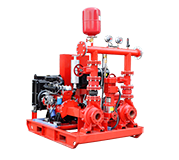
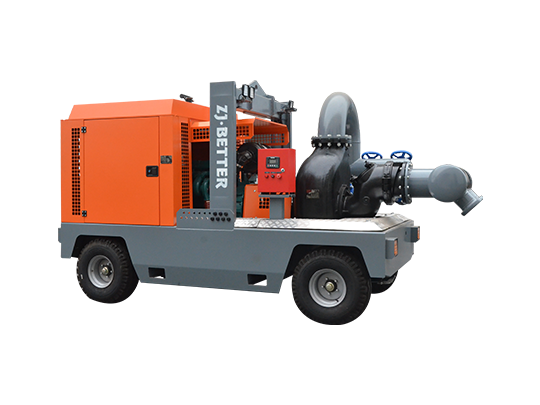
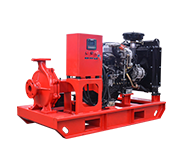
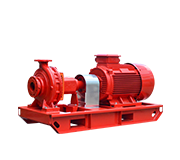

1. Integrated Skid-Mounted Structure for Centralized Installation
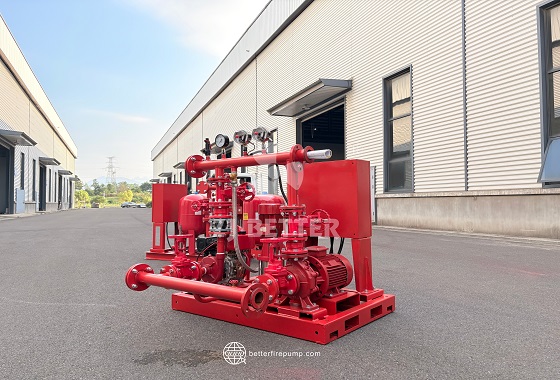
The system utilizes a common steel base to house the fire pumps and auxiliary components, forming a unified, integrated equipment assembly. This design minimizes the need for complex spatial coordination and individual component positioning during installation, while simplifying transport, lifting, and on-site placement.
2. Compact Layout for Optimized Space Utilization
Functional components are strategically arranged based on their dimensions and connection requirements, eliminating unnecessary gaps between individual units. This compact configuration is ideal for projects with limited fire pump room space or those requiring a centralized water-supply equipment layout.
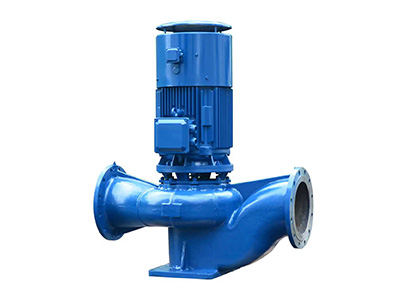
3. Fire Pumps as the Core Water-Supply Component
The fire pumps serve as the primary hydraulic components, pressurizing the water source and delivering it into the fire-protection piping network. The specific pump type and specifications—such as flow rate, head, and resistance handling—are selected based on project requirements, ensuring the system’s performance aligns precisely with the fire-protection design.
4. Centralized Control and Management
The system features a dedicated fire pump control cabinet, which manages the starting and stopping of the pumps and monitors their operational status. Depending on the control scheme, the system can support automatic or manual operation, provide status indicators, and trigger fault alarms, allowing operators to easily monitor the equipment and perform routine management.
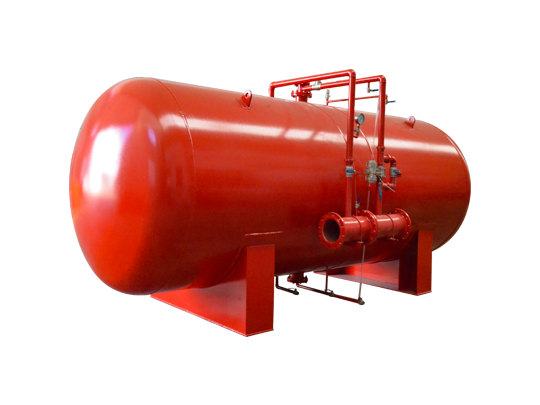
5. Pressure Tanks for Piping Network Pressure Management
Depending on the system design, a pressure tank can be included to provide pressure storage and buffering for the piping network. When paired with a pressure-maintenance (jockey) pump, the pressure tank helps manage minor, routine pressure fluctuations, preventing the main fire pumps from starting unnecessarily due to slight pressure drops.
6. Integrated Piping and Valves for Seamless System Connection
6. Integrated Piping and Valves for Seamless System Connection
These packaged systems can be configured to include inlet and outlet piping, flanges, check valves, gate valves, and pressure-monitoring accessories, tailored to specific project requirements. Centralized planning of piping connections clarifies internal water flow paths, minimizes redundant on-site piping work, and facilitates future inspections and maintenance.
7. Flexible Power Configurations to Meet Diverse Project Needs
Depending on the fire-water supply strategy, systems can be equipped with either electric-motor-driven or diesel-engine-driven fire pumps, along with the necessary auxiliary equipment. Since each power type is suited to specific conditions, the final configuration should be determined based on factors such as the project’s power supply reliability, backup power requirements, and the operating environment.
8. Pre-assembled Design to Simplify On-site Construction
Key equipment and connecting components are laid out and integrated during the factory-packaging phase, significantly reducing the need for individual positioning and assembly at the job site. Once the equipment arrives, the remaining tasks—securing it to the foundation, connecting inlet/outlet piping, performing electrical wiring, and conducting commissioning and acceptance testing—can be carried out according to the engineering drawings.
9. Modular Configuration for Easier Maintenance
With clearly defined functional divisions—such as the pump unit, control cabinet, pressure components, and valve/piping assemblies—maintenance personnel can easily inspect individual parts. Adequate space is reserved for servicing, and routine tasks such as lubrication, tightening of fasteners, electrical checks, and operational testing help ensure the equipment remains in optimal working condition.
10. Customization Based on Engineering Parameters for Broad Application
Different building and industrial projects have unique requirements for fire-water flow rates, head, pressure, and installation space. These skid-mounted systems can be customized—adjusting pump types, power sources, control schemes, and auxiliary components—to suit a wide range of applications, including industrial plants, storage facilities, commercial buildings, and other fixed fire-water supply installations.
Compact skid-mounted fire pump systems integrate fire pumps, control equipment, pressure components, and associated piping accessories onto a common base. By consolidating water supply, control, and auxiliary functions, these systems offer a compact layout, well-organized components, reduced on-site installation requirements, and highly flexible configuration options. Actual equipment selection should be based on the design requirements of the fire protection system, taking into account factors such as flow rate, head, power conditions, piping connections, and maintenance space, in order to determine a comprehensive equipment solution suitable for the project.
 WhatsApp me