

1. Independent Diesel Engine Drive
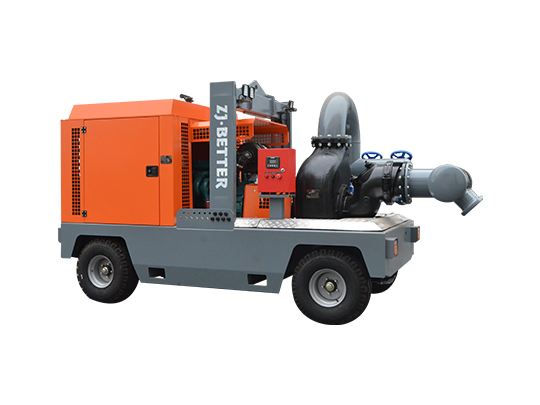
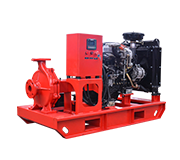
The unit employs a diesel engine as the primary power source for the fire pump, driving the pump assembly via mechanical transmission without relying solely on the fixed electrical grid. Diesel power provides an independent mechanical drive for the fire pump in scenarios requiring backup power or where on-site power supply is limited.
2. Vertical Structure for Efficient Space Utilization
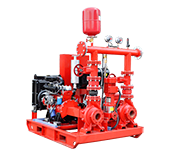
The product features a vertical layout that consolidates the pumping system, diesel engine, and related components, thereby minimizing the equipment's horizontal footprint while fulfilling fire-fighting water supply requirements. Actual installation requires proper planning regarding pump room dimensions, maintenance clearances, and piping routes.
3. Fire Pump Performs Core Water Supply Function
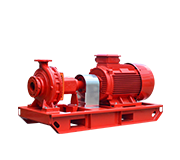
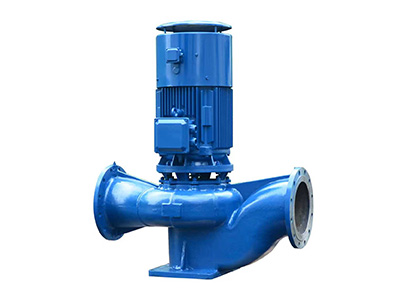
The fire pump converts the mechanical energy output by the diesel engine into water pressure and velocity via impeller rotation, delivering water to the fire-fighting piping network and terminal facilities. The specific pump model is selected based on the project's required flow rate, head, and installation conditions.
4. Matching Power Parameters with Hydraulic Performance
The diesel engine's power rating is determined based on the fire pump's flow rate, head, rotational speed, and actual operating conditions. Proper power matching ensures the engine output aligns with the pump assembly's hydraulic performance, preventing issues such as insufficient power or incompatibility with design operating conditions.
5. Supports Automatic Control and Operation
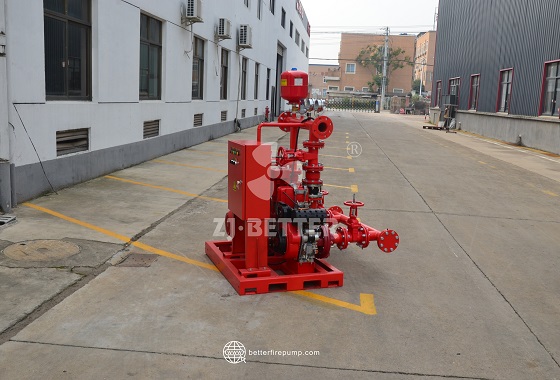
The unit can be equipped with a dedicated control cabinet for centralized management of the diesel fire pump and auxiliary equipment, allowing for the configuration of automatic or manual operating modes. By utilizing pressure detection signals, the system executes startup and operational management according to preset control logic.
6. Pressure Monitoring and Auxiliary System Management
6. Pressure Monitoring and Auxiliary System Management
In accordance with fire protection system design requirements, monitoring components such as pressure gauges and pressure sensors can be installed to monitor the operating pressure of the piping network and pump assembly. The resulting pressure signals serve as a basis for the control system's operational logic, enabling operators to keep track of equipment status.
7. Configurable Pressure Stabilization and Control Components
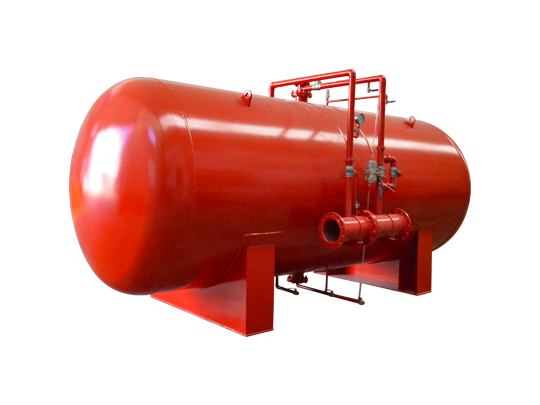
A complete fire water supply system can be configured with jockey pumps (pressure-maintaining pumps), pressure tanks, and pressure monitoring components based on design specifications. Pressure stabilization components primarily handle minor pressure fluctuations within the fire piping network and work in coordination with the main fire pumps and control system to ensure a reliable water supply.
8. Comprehensive Auxiliary Piping Configuration
Depending on project requirements, the equipment can be fitted with components such as check valves, gate valves, pressure gauges, pressure sensors, flanges, flexible joints, and inlet/outlet piping. This integrated configuration facilitates connection to the on-site fire piping network while simplifying subsequent pressure testing, valve inspections, and pipeline maintenance.
9. Flexible Parameter Configuration
As different fire protection projects vary in their requirements for flow rate, head, pressure, pipe diameter, and power configuration, the equipment is not limited to a single, fixed specification. Suitable fire pumps, diesel engines, and control components can be selected based on specific project design parameters to ensure the entire system is optimally matched to the fire piping network.
10. Suitable for Diverse Fire Protection Projects
Vertical diesel fire water supply equipment is suitable for use in various scenarios, including industrial plants, warehousing and logistics facilities, commercial buildings, ports, airports, power facilities, and petrochemical projects. Actual model selection should be determined by comprehensively considering fire protection design requirements, water source conditions, flow rate, head, piping network resistance, and the installation environment.
Powered by an independent diesel engine, the vertical diesel fire water supply unit performs the core water delivery function via a fire pump. It can be integrated with a control cabinet, pressure monitoring devices, pressure stabilization components, and auxiliary piping to form a complete fire water supply system. Its vertical layout optimizes the use of installation space, while the independent diesel power source makes it ideal for fire protection projects requiring backup or autonomous power support. By appropriately matching engine power, fire pump performance, and control components, tailored fire water supply equipment solutions can be developed to meet the specific flow rate, head, and pressure requirements of different projects.
 WhatsApp me