
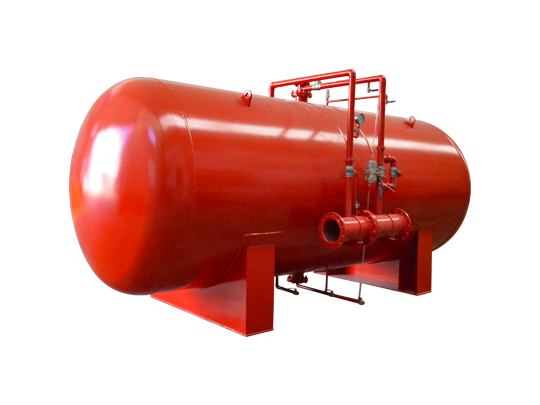

1. Large-capacity pressure tank for pressure storage
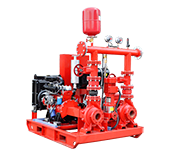
The equipment is equipped with a large fire-fighting pressure tank capable of storing pressurized fire-fighting water during normal standby and buffering against pressure fluctuations in the piping network. When there is low-flow water usage or a slight drop in pressure, the stored pressure can compensate for the loss, thereby reducing unnecessary starts of the pressure-maintaining pump.
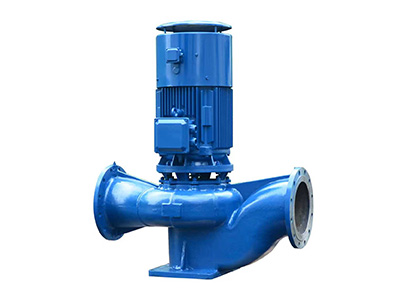
2. Pressure-maintaining pump for continuous network pressure maintenance
The pressure-maintaining pump is a key power component of the system, primarily responsible for managing daily pressure fluctuations in the fire piping network. When the pressure falls below the set value, the pump activates based on control signals to replenish pressure, restoring the network pressure to the desired range and maintaining the system's standby readiness.
3. Pressure sensing for real-time status monitoring
The equipment continuously monitors pressure changes in the fire piping network via pressure-sensing devices and feeds the relevant signals back to the control system. By appropriately setting the start and stop pressure thresholds, the pressure-maintaining pump operates in response to actual network conditions, enhancing the timeliness and accuracy of the automatic pressure replenishment process.
4. Automatic control to minimize manual intervention
The control cabinet manages equipment operation and status, automatically controlling the starting and stopping of the pressure-maintaining pump based on pressure sensor signals. Once the network pressure returns to the set range, the system ceases pressure replenishment and reverts to standby mode, enabling automatic detection, startup, replenishment, and shutdown.
5. Synergistic operation of pressure tank and pump to reduce frequent cycling
The pressure tank handles pressure storage and buffering, while the pressure-maintaining pump performs active pressure replenishment; their combined operation allows for the handling of minor pressure fluctuations without frequently cycling the pump. This also helps prevent the main fire pump from starting due to minor pressure variations, ensuring smoother overall operation of the fire water supply system.
6. Centralized component configuration enhances system integrity
6. Centralized component configuration enhances system integrity
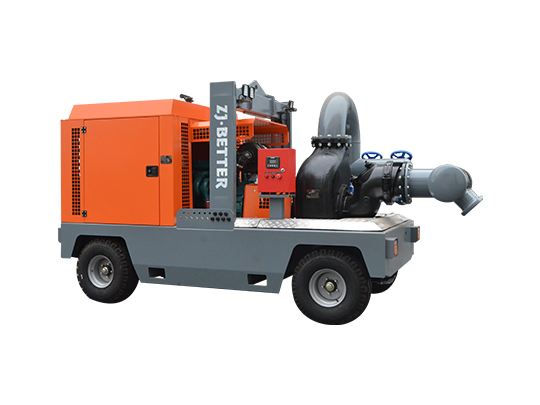
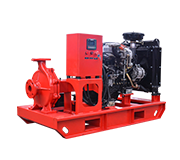
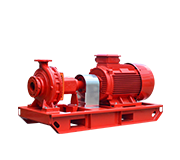
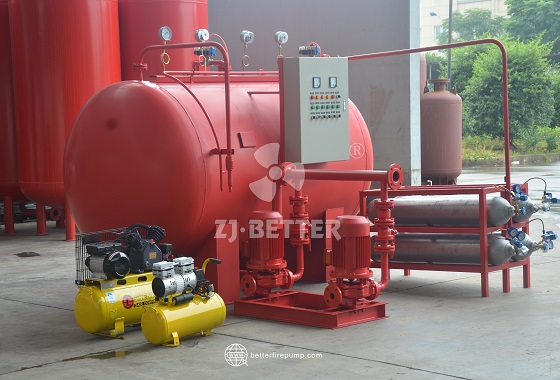
Large-scale pneumatic fire water supply systems systematically integrate components such as pressure tanks, pressure-maintaining pumps, control cabinets, pressure-sensing devices, valves, and piping. These components work in concert to maintain pressure within the fire-fighting piping network, forming a complete, automatic pressure-stabilizing water supply unit that facilitates installation and equipment management.
7. Stable pressure supports the startup of main fire pumps
Maintaining appropriate piping network pressure is crucial when the fire-fighting system is in standby mode. Pressure-stabilizing equipment continuously maintains the design pressure and compensates promptly for fluctuations, thereby establishing the necessary pressure conditions for the subsequent startup of main fire pumps and ensuring a reliable water supply to fire-fighting facilities.
8. Flexible equipment operation modes
Depending on the control system configuration, the equipment supports various operating modes—such as automatic and manual—facilitating daily operation, maintenance, and commissioning. The control cabinet displays information regarding pressure, operating status, and faults, and issues alarms, allowing personnel to intuitively monitor the equipment's working condition.
9. Suitable for diverse fire water supply projects
These large-scale pneumatic fire water supply systems are applicable to facilities requiring long-term maintenance of fire-fighting network pressure, such as high-rise buildings, commercial complexes, industrial plants, logistics warehouses, hospitals, schools, data centers, and municipal fire-fighting projects. Specific equipment parameters should be configured according to project design requirements.
10. Rational selection based on project parameters
Equipment selection should not be based solely on maximizing pressure tank capacity or pump power; rather, it requires matching specifications to the system's design pressure, pressure stabilization range, network volume, pressure loss, required flow rate, head, and installation environment. A rational configuration of pumps, tanks, and control parameters ensures a balance between pressure stabilization performance, operational stability, and equipment service life.
Based on energy storage via pressure tanks and powered by pressure-stabilizing pumps, these large-scale pneumatic fire water supply systems utilize pressure sensing and automatic control as their core functions. By integrating pressure storage, stabilization, monitoring, and control, they maintain the fire-fighting network at the proper standby pressure while minimizing unnecessary, frequent start-stop cycles of the pump units. For high-rise buildings, industrial plants, warehousing facilities, and large-scale fire protection projects, the proper integration of pressure tanks, pressure-stabilizing pumps, control systems, and piping components enables the creation of a more stable and standardized fire protection pressure maintenance system, providing reliable auxiliary support for the normal operation of main fire pumps and various fire protection facilities.
 WhatsApp me