

1. Independent Diesel Power
The unit utilizes a diesel engine to drive the fire pump, eliminating reliance on electric motors as the sole power source. This provides an independent mechanical drive when backup power is needed or fixed power supply conditions are limited, enhancing the flexibility of the fire water supply system configuration.
2. Optimized Power-Pump Matching
The diesel engine's power output is selected based on the fire pump's required flow rate, head, rotational speed, and operating conditions, ensuring an optimal match between power output and pump performance. Engines and pumps of appropriate specifications can be configured to meet the specific parameters and actual water supply needs of different projects.
3. Stable Fire Pumping
The fire pump converts mechanical energy into water pressure via impeller rotation, ensuring continuous fire water delivery. Various pump models can be selected based on project requirements, allowing the equipment to adapt to different flow rates, heads, and piping network resistance conditions while providing stable hydraulic output for the fire system.
4. Efficient Power System Coordination
The diesel engine and fire pump are configured as a matched set, with engine power transmitted directly to drive the impeller. This optimized power configuration ensures stable operation and meets the demands of various fire water supply scenarios.
5. Centralized Control and Management
The unit features a control cabinet for centralized management of the fire pump's operating status, supporting both automatic and manual control modes. Integrated components, such as pressure sensors, monitor operating parameters, providing the necessary data to control pump start/stop sequences and facilitate daily management.
6. Comprehensive Cooling System
Continuous diesel engine operation generates heat; therefore, the unit is equipped with a dedicated cooling system to regulate the engine's operating temperature. An effective cooling configuration ensures the power system operates reliably and meets the requirements for continuous fire equipment operation.
7. Skid-Mounted Integrated Structure
7. Skid-Mounted Integrated Structure
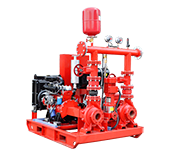
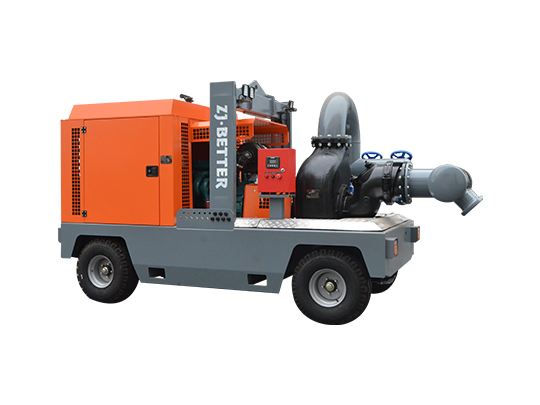
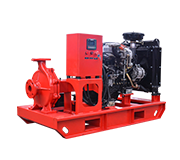
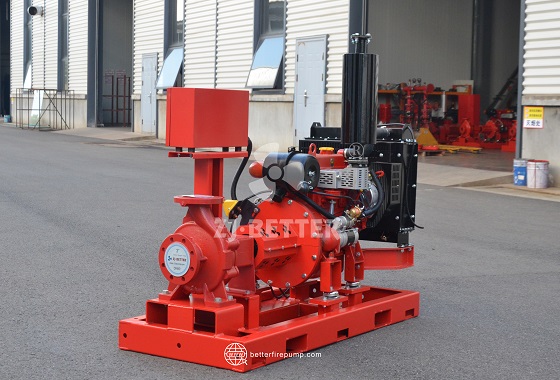
The engine, fire pump, control cabinet, cooling system, and related components are centrally mounted on a common base, forming a complete skid-mounted unit. This integrated structure minimizes the installation work associated with distributed equipment layouts and facilitates transportation, positioning, and on-site connections.
8. Compact Equipment Layout
Functional components are arranged centrally based on power, pumping, and control requirements, optimizing the overall structure while ensuring adequate space for operation and maintenance. For projects requiring centralized fire-fighting equipment installation, this compact layout improves space utilization.
9. Flexible Engineering Configuration
The unit can be selected based on the specific flow rate, head, pressure, water source conditions, and piping network parameters of a project; various specifications of diesel engines and fire pumps can be combined. Actual equipment specifications should be determined based on fire protection design requirements and on-site operating conditions.
10. Multi-Scenario Fire Protection Applications
The integrated diesel fire pump unit is suitable for fire water supply projects in industrial plants, warehouses, logistics facilities, commercial buildings, docks, airports, power plants, and petrochemical facilities. Pump types, power specifications, and control configurations can be adjusted to meet the specific fire water supply requirements of different application scenarios.
By centrally configuring the diesel engine, fire pump, control cabinet, and cooling system, the integrated diesel fire pump unit achieves coordinated operation of power drive, fire pumping, and operational management functions. Its independent diesel power, optimized power matching, stable pumping performance, centralized control, and skid-mounted structure allow for flexible configuration to meet the flow, head, and pressure requirements of various fire protection projects. In practical applications, professional equipment selection—based on fire design parameters, water source conditions, piping network resistance, and the installation environment—is essential to ensure the unit's performance aligns with fire water supply needs.
 WhatsApp me