

1. Independent Diesel Power
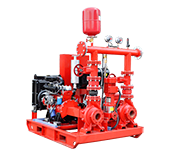
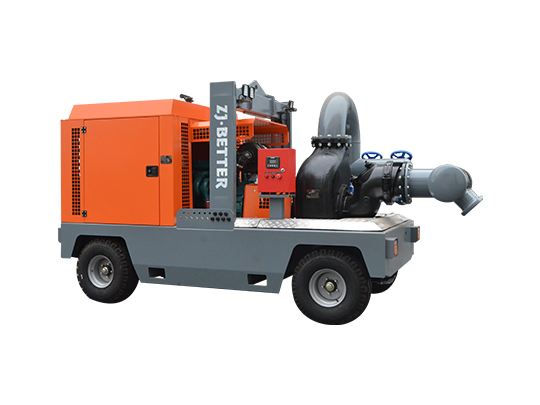
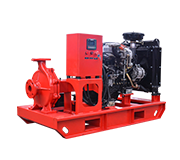
The system utilizes a diesel engine as the primary power source for the main fire pump. This ensures the pump can operate via independent mechanical power even during mains power failures, providing backup water supply capabilities—making it ideal for projects requiring high reliability in continuous fire-fighting water supply.
2. High-Efficiency Fire Pumping
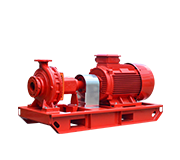
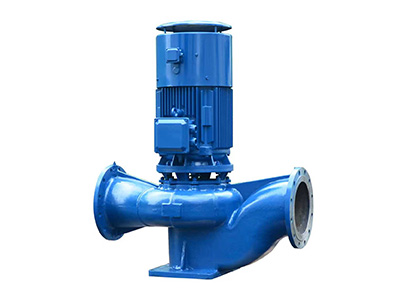
The main fire pump converts mechanical energy into hydraulic pressure energy through impeller rotation, enabling the pressurized delivery of fire-fighting water. Depending on project requirements for flow rate, head, and piping network resistance, various pump configurations—such as end-suction pumps, horizontal split-case pumps, or multistage pumps—can be selected to ensure optimal performance matching the actual system parameters.
3. Jockey Pump for Pressure Maintenance
The jockey pump handles routine, low-flow pressure compensation for the fire-fighting piping network. When a slight pressure drop occurs, the jockey pump activates first to restore pressure; this prevents the main fire pump from starting frequently due to minor fluctuations and helps maintain the network in a pressurized standby state.
4. Stable Operation via Pressure Control
The equipment monitors piping network pressure using components such as pressure gauges and sensors, transmitting signals to the control system. Based on preset pressure ranges, the system regulates pressure by activating the appropriate pumps, ensuring the water supply equipment maintains optimal pressure levels across various operating conditions.
5. Pressure Storage and Buffering
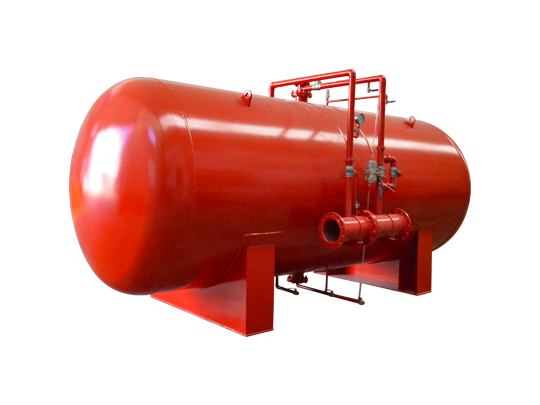
Depending on the configuration, the system can include a pressure tank. By storing pressurized fire-fighting water and buffering pressure fluctuations, the tank works alongside the jockey pump to handle low-flow pressure demands. This reduces unnecessary main pump starts and enhances the overall pressure stability of the fire-fighting water supply system.
6. Automatic Control and Management
6. Automatic Control and Management
The control cabinet enables centralized control of the diesel fire pump, jockey pump, and related auxiliary equipment. Depending on the specific configuration, it supports automatic or manual operation, start-up control, status monitoring, and fault alarms. It also incorporates protective functions—such as overcurrent and overload protection—to enhance the convenience of equipment management.
7. Collaborative Operation of Multiple Components
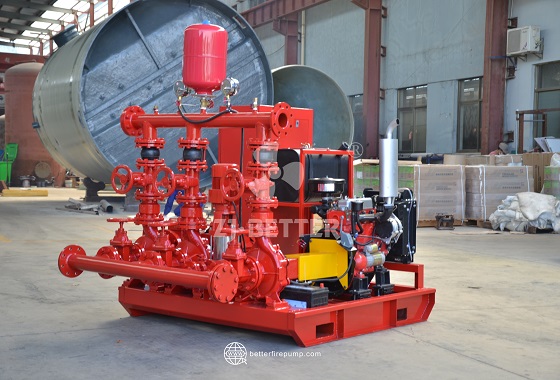
The diesel engine provides power output; the main fire pump handles the primary firefighting water supply; the jockey pump maintains system pressure during normal operation; pressure sensing devices provide real-time data; and the control cabinet manages the overall operational logic. These functional components work in concert under various operating conditions to form a complete firefighting water supply system.
8. Skid-Mounted Integrated Structure
The system integrates the primary power unit, pumping assembly, control unit, and piping onto a common base. This compact layout minimizes the need for on-site assembly and interconnection, while facilitating transport, positioning, installation, and subsequent maintenance, making it suitable for diverse fire pump rooms and project sites.
9. Flexible Matching of Engineering Parameters
The diesel fire pump package is not limited to a single, fixed configuration; models can be selected based on project-specific requirements such as flow rate, head, pipe diameter, system pressure, diesel engine power, and installation environment. The product range covers flow rates of approximately 30–9,000 GPM and heads of 3–20 bar, with specific parameters determined by actual fire protection design requirements.
10. Suitability for Various Fire Protection Projects
With its independent power source, stable pumping performance, pressure control capabilities, and integrated structure, the system is suitable for firefighting water supply projects in industrial plants, logistics warehouses, commercial buildings, airports, ports, power facilities, and petrochemical sites, providing configurable emergency water supply solutions for diverse scenarios.
This high-efficiency diesel fire pump package integrates power, pumping, and pressure management systems by coordinating functions such as independent diesel power, high-efficiency fire pumps, jockey pumps, pressure sensing, pressure accumulation, and automatic control. It meets firefighting flow and pressure requirements while enhancing overall system integration and adaptability to engineering projects. The skid-mounted structure facilitates transport, installation, and maintenance, while flexible pump model and parameter configurations allow the system to meet the specific needs of various fire protection projects. For facilities requiring a reliable emergency fire water supply—such as industrial sites, warehouses, ports, airports, and large-scale buildings—a comprehensive fire water supply system can be established by appropriately configuring diesel engines, main fire pumps, jockey pumps, and control systems.
 WhatsApp me