

1. Multi-pump parallel operation to enhance water supply capacity
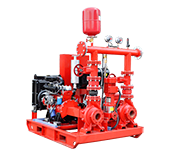
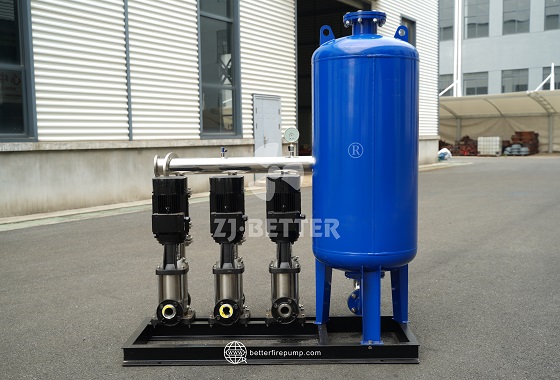
The equipment uses multiple vertical multistage pumps operating in parallel, allowing for flexible deployment of different numbers of pumps based on the actual water consumption of the fire-fighting pipe network. When water consumption is low, a single pump can meet the demand; as water consumption increases, the number of operating pumps can be increased, thereby improving the overall water supply capacity of the system.
2. Vertical Multistage Structure Achieves High Head
Vertical multistage pumps increase water pressure through multiple impellers, achieving high head output within a relatively small equipment size. Product data shows that vertical multistage pumps can handle flow rates from 6 to 600 m³/h and heads from 20 to 270 m, with parameters selectable according to project requirements.
3. Constant Pressure Water Supply Maintains Pipeline Stability
The system continuously monitors pipeline pressure changes through a pressure detection device and automatically adjusts pump operation based on the set pressure. When pressure drops, the number of pumps is activated or increased; once the pressure reaches the set range, the number of operating pumps is reduced, thus minimizing pressure fluctuations.
4. Pressure Tank Provides Pressure Storage and Buffering
The equipment is equipped with a pressure tank as a pressure storage device, storing a certain amount of pressure energy. This provides pressure compensation during low-flow water use or minor pipeline leaks, reducing frequent pump starts. An internal diaphragm separates the water chamber and the air chamber, allowing compressed gas to store and release pressure energy.
5. Multi-Pump Collaboration Adapts to Different Operating Conditions
The water demand of fire protection systems varies significantly at different times. Multi-pump configurations can be combined to operate according to actual pressure and flow requirements, preventing the equipment from always running at full capacity. A reasonable multi-pump linkage method helps improve system operational flexibility and reduce unnecessary equipment operating costs.
6. Compact Structure Saves Pump Room Space
Vertical multistage pumps are installed vertically, with the pump body and motor arranged in the same direction, reducing the floor space compared to some traditional horizontal equipment. For building projects with limited fire pump room space, this structure facilitates optimized equipment layout and piping installation.
7. High-Efficiency Hydraulic Design
Multi-stage impellers and guide structures can progressively increase water pressure, enabling the pump unit to maintain stable hydraulic performance in high-lift water supply scenarios. Official website data shows that vertical multistage pumps use an optimized hydraulic model and emphasize high efficiency, low vibration, and low noise operation.
8. Enhanced Operational Ease through Automated Control
Pump sets can be equipped with control cabinets, pressure sensors, and related control components to automatically control pump start-up, shutdown, and operation combinations based on changes in pipeline pressure. Automated control reduces manual intervention and facilitates monitoring of equipment status and daily management.
9. Applicable to Various Fire Protection Projects
This type of constant-pressure fire pump set can be used in fixed fire hydrant systems, automatic sprinkler systems, and other water supply systems requiring stable fire pressure. It is also suitable for high-rise residential buildings, commercial buildings, hospitals, schools, industrial plants, and warehousing centers.
10. Flexible Matching of Project Parameters
Different fire protection projects have different requirements for flow rate, head, pipe diameter, and power. Therefore, pump sets can be configured according to the actual parameters of the project. Related vertical multistage fire pump products cover different flow rate, head, and power ranges, providing more flexible selection options for high-rise buildings and large-scale fire protection systems.
The fire-fighting constant pressure water supply pump set utilizes multiple vertical multistage pumps, a pressure tank, pressure detection devices, and an automatic control system to maintain continuous pressure in the fire-fighting pipeline network and flexibly adjust water supply capacity. Its vertical multistage structure features a small footprint, high head, and stable operation. Multiple pumps operating in parallel can adapt to different flow requirements, while the pressure tank buffers pressure changes and reduces frequent pump start-ups and shutdowns. With its compact structure, stable hydraulic performance, automated control, and flexible engineering configuration, this product provides reliable fire-fighting constant pressure water supply support for high-rise buildings, commercial complexes, industrial plants, warehousing facilities, and large public buildings. It is a professional pump set suitable for pressure stability and automatic pressurization requirements in modern fire-fighting water supply systems.
 WhatsApp me