

1. Deep Well Water Intake Capacity Meets Firefighting Needs in Remote Areas
Mines and large industrial parks are often located in remote areas with limited municipal fire water supply. Therefore, fire protection systems typically rely on underground water sources, rivers, reservoirs, or storage tanks for independent water supply. Remote fire water supply pump systems utilize a vertical long-shaft deep well structure, allowing for stable water intake from deep wells or deep water areas. Compared to ordinary surface fire pumps, it has a stronger deep-water extraction capacity, effectively solving the problem of difficult access to fire water sources in remote areas. In mining projects, due to the large operating area and complex terrain, fire protection equipment needs to have a stable long-distance water supply capability. Vertical long-shaft fire pumps, through multi-stage impellers and high-lift design, can quickly deliver deep well water to the main fire protection network, ensuring the entire mining area's fire protection system is always in a stable standby state. This independent deep well water intake capability not only improves the project's fire safety level but also reduces dependence on external water supply networks, providing more reliable fire protection for large industrial projects.
2. High-Lift, Long-Distance Water Delivery Suitable for Large-Scale Industrial Scenarios
Mines, industrial parks, and large infrastructure projects typically cover vast areas, requiring fire-fighting water supply systems to deliver stable water over long distances. Remote fire-fighting pump systems, through optimized hydraulic structure design, can achieve high-lift, high-flow-rate continuous water supply. Vertical long-shaft fire pumps can be configured with different numbers of impeller stages according to the actual needs of the project, thus meeting the high-pressure water delivery requirements under complex operating conditions. Whether in high-altitude mining areas or within long-distance fire-fighting pipeline networks within large industrial plants, the equipment can maintain stable pressure output. For high-risk areas such as petrochemical parks, large storage bases, and port terminals, fire-fighting systems must rapidly and continuously supply water to key areas after a fire breaks out. High-lift, long-distance water delivery capabilities effectively improve fire emergency response efficiency, preventing fire spread due to insufficient water supply. Simultaneously, the optimized flow channel structure reduces energy loss during water delivery, improves overall water supply efficiency, and provides a more stable and reliable fire-fighting water source guarantee for large projects.
3. Vertical Long-Shaft Structure Enhances Equipment Operational Stability
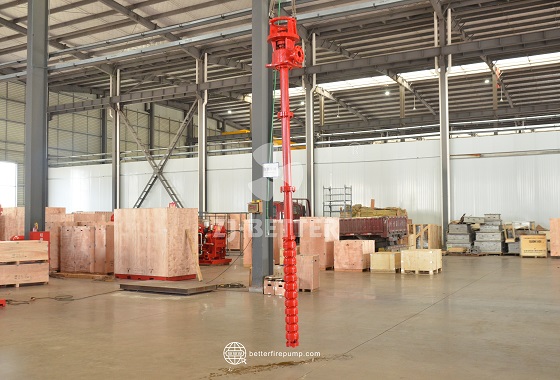
Long-distance fire-fighting water supply pump systems typically employ a vertical long-shaft structure design. This structure effectively improves equipment operational stability and adaptability to deep wells. Compared to traditional horizontal fire pumps, the power unit of the vertical long-shaft pump is located on the ground, while the impeller assembly operates underwater. This design not only reduces the footprint but also lowers the risk of equipment being affected by flooding and complex environments. The long-shaft structure utilizes high-strength couplings and wear-resistant bearings for support, effectively reducing vibration and mechanical wear during long-term operation. Simultaneously, the vertical installation method reduces internal hydraulic displacement within the pump body, improving the overall operational balance of the equipment. For mining and industrial projects, fire-fighting equipment often needs to be on standby for extended periods or even operate continuously, making structural stability particularly critical. The vertical long-shaft fire pump, with its stable and reliable mechanical structure, effectively ensures the long-term safe operation of the fire-fighting system.
4. Intelligent Automatic Control Improves Fire Response Efficiency
Modern industrial fire-fighting systems increasingly emphasize intelligent and automated management capabilities. Remote fire-fighting water supply pump systems are typically equipped with intelligent control cabinets, enabling automatic detection, automatic start/stop, fault alarms, and remote monitoring. When the fire pipeline pressure drops or the fire alarm system issues a start signal, the equipment can quickly and automatically start, ensuring stable water supply. This automatic response capability significantly shortens the emergency response time in the early stages of a fire. The intelligent control system can also monitor equipment operating parameters in real time, including pressure, current, voltage, water level, and operating status. If an abnormality occurs in the system, the equipment will automatically alarm and activate protection procedures, thereby reducing the risk of equipment failure. For large mines and industrial parks, centralized intelligent management can effectively reduce the workload of manual inspections and improve the overall management efficiency of the fire protection system. With the continuous development of the smart fire protection concept, intelligent control has become a crucial core function of modern remote fire-fighting water supply systems.
5. Integrated Modular Design Reduces Engineering Construction Difficulty
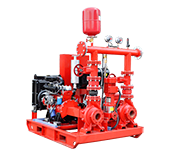
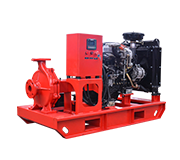
Traditional fire-fighting water supply systems typically require extensive on-site equipment assembly and pipeline connection work, resulting in a long construction cycle. Modern remote fire-fighting water supply pump systems increasingly tend to adopt modular and integrated designs. The equipment integrates fire pumps, motors, control cabinets, valve systems, and piping components onto a single base platform, forming a complete skid-mounted fire water supply system. This not only reduces on-site installation work but also improves overall project deployment efficiency. For mining projects and remote industrial areas, on-site construction conditions are often complex, and the integrated modular design significantly reduces installation difficulty and construction risks. Simultaneously, the modular structure facilitates equipment transportation, future expansion, and maintenance management, better meeting the efficiency and flexibility requirements of modern large-scale engineering projects.
6. Industrial-Grade Durable Structure Adapts to Complex Operating Environments
Mining and industrial park environments typically involve complex factors such as high temperatures, dust, humidity, corrosive media, and continuous vibration. Therefore, fire-fighting equipment must possess strong environmental adaptability. Remote fire water supply pump systems typically employ an industrial-grade heavy-duty structural design, with key components manufactured using high-strength materials and corrosion-resistant processes to improve long-term operational reliability. For example, pump shafts and impellers can be made of stainless steel or wear-resistant alloys to prevent corrosion and wear during long-term operation; the external structure utilizes anti-corrosion coatings and sealing designs to enhance the equipment's resistance to moisture and dust. For long-term operating mine fire protection systems, equipment stability directly impacts the overall project's safety assurance capabilities. Industrial-grade durable structures not only extend equipment lifespan but also reduce subsequent maintenance costs.
7. Continuous Water Supply Capacity Ensures Fire Safety in Large Projects
In large industrial projects, fire suppression typically requires a continuous water supply for extended periods; therefore, fire protection equipment must possess stable and continuous operating capabilities. The remote-controlled fire water supply pump system employs a high-efficiency impeller and optimized flow channel structure design, enabling stable operation under high loads for extended periods. Even when multiple fire zones are activated simultaneously, the system maintains stable water pressure and flow output. Continuous water supply capacity is particularly crucial for underground mining areas, large storage bases, and petrochemical facilities. Interruptions in fire water supply can lead to rapid fire spread and severe losses. Therefore, stable and reliable continuous water supply performance is one of the core values of the remote-controlled fire water supply system in large-scale industrial fire protection projects.
8. Wide Applicability to Various Industrial Fire Protection Scenarios
The remote-controlled fire water supply pump system has strong scenario adaptability and can be widely applied in projects such as mines, industrial parks, ports, power facilities, and large-scale warehousing and logistics centers. In mining engineering, the equipment can meet the needs of deep well water intake and long-distance water transportation; in port and dock projects, it can provide fire-fighting water supply from seawater or large reservoirs; in industrial parks, it can provide continuous and stable fire protection for high-risk production areas. Furthermore, petrochemical, power plant, steel plant, and large infrastructure projects also have extremely high requirements for the stability and reliability of fire-fighting water supply systems. Remote fire-fighting water supply pump systems, with their flexible configuration capabilities, can meet the needs of fire-fighting engineering in different fields. As the scale of modern industry continues to expand, the market demand for this type of high-performance fire-fighting water supply equipment is also continuously growing.
9. Energy-efficient design reduces long-term operating costs
Large industrial fire-fighting systems typically require long-term operation, therefore, equipment energy consumption is increasingly important. Modern remote fire-fighting water supply pump systems can effectively reduce operating energy consumption through optimized hydraulic models, high-efficiency motors, and intelligent frequency conversion technology. The system can automatically adjust its operating status according to actual pressure demand, avoiding ineffective energy consumption and frequent start-stop problems. At the same time, the high-efficiency impeller design can also reduce hydraulic losses and improve overall water supply efficiency. For large industrial parks and mining projects, long-term energy-efficient operation translates to lower operating costs and higher economic benefits. Energy-saving design not only aligns with modern green industrial development trends but also further enhances the overall competitiveness of fire protection equipment.
10. Smart Firefighting Drives Future Upgrades of Remote Water Supply Systems
With the rapid development of smart cities and digital industry, remote fire water supply systems are also upgrading towards greater intelligence. Future equipment will further integrate the Internet of Things, cloud platforms, and big data analytics to achieve real-time monitoring and predictive maintenance of equipment operation. Managers can view equipment operation in real time through a remote platform and proactively identify potential fault risks. Simultaneously, automatic diagnostics, remote control, and intelligent linkage functions will further improve the overall response efficiency and safety management level of the fire protection system. In the future, remote fire water supply pump systems will not merely be single water supply devices but an important component of modern smart fire protection systems.
Remote fire water supply pump systems, with their advantages of deep well water intake, high-lift water delivery, stable operation, and intelligent control, have become key core equipment in fire protection systems for mines and large industrial parks. It not only solves the problem of fire-fighting water supply in remote areas, but also significantly improves the level of fire safety in modern industry through continuous and stable water supply and intelligent management. With the continuous expansion of industrial projects and the ongoing development of smart fire protection technology, remote fire-fighting water supply pump systems will play an increasingly important role in mines, ports, petrochemical plants, power facilities, and large-scale infrastructure projects. In the future, more efficient, intelligent, and energy-saving remote fire-fighting water supply equipment will continue to drive the development of modern industrial fire protection engineering towards greater safety and reliability.
 WhatsApp me