

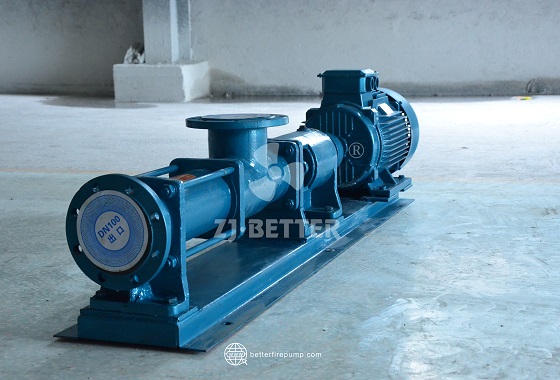
1. Constant-volume structure ensures high-precision foam additive metering. The single-screw pump is a typical constant-volume pump. Its working principle relies on the formation of a closed cavity between the rotor and stator, with continuous axial movement, resulting in a fixed and stable output volume per revolution. When used to deliver foam additives, it can achieve high-precision metering to ensure that the foam-to-water ratio meets fire extinguishing standards. For example, at a mixing ratio requirement of 3% or 6%, the single-screw pump can guarantee extremely low flow deviation and will not be affected by pressure fluctuations in output. For industrial foam systems requiring precise proportioning, this constant-volume metering advantage significantly improves fire extinguishing efficiency, reduces additive waste, and ensures stable proportioning accuracy during long-term operation.
2. Continuous, pulsation-free supply ensures stable foam system pressure. Traditional positive displacement or centrifugal pumps often suffer from large outlet pressure fluctuations and unstable flow rates in low-flow foam delivery, easily affecting foam mixing quality. Single-screw pumps, due to their continuous chamber pushing structure, achieve truly pulsation-free supply, delivering fluid with linear flow characteristics. This operating mode effectively avoids pressure oscillations in the foam proportioner, resulting in more stable foam output quality and preventing pipeline vibration and accessory wear caused by pressure shocks. In high-risk conditions and foam stations requiring 24-hour continuous operation, the stable liquid supply capability of single-screw pumps is particularly crucial, providing a reliable basic flow guarantee for the entire fire extinguishing system.
3. Suitable for delivering high-viscosity, multi-type fire-fighting foam liquids. A wide variety of fire-fighting foam additives are available, including protein foam, fluoroprotein foam, synthetic foam, alcohol-resistant foam, and some specialized high-viscosity fire extinguishing agents. The viscosity of different fluids varies significantly, which can easily lead to problems such as insufficient flow, pump blockage, or discontinuous delivery in traditional pump types. Single-screw pumps, however, are highly adaptable to a wide viscosity range, stably delivering liquids from low to high viscosity. Their stator elastomer fits tightly with the rotor, forming a sufficiently sealed cavity, allowing even high-viscosity foam liquid to be smoothly propelled without additional heating or dilution. This makes single-screw pumps suitable for almost all fire-fighting foam delivery conditions, improving the system's versatility and reliability.
4. Strong self-priming capability, suitable for long-distance and complex layouts. Single-screw pumps have excellent self-priming capabilities, automatically drawing foam liquid without priming, achieving rapid start-up. This is particularly crucial for foam systems, as fire-fighting equipment typically requires quick commissioning, and waiting for priming affects system response speed. Furthermore, single-screw pumps can achieve long-distance delivery and stable operation in complex pipeline layouts, without significant flow reduction due to increased pipeline length or bends. This characteristic makes them widely applicable to the long-distance delivery needs of large oil depots, chemical plants, port fire-fighting foam systems, and fixed-proportioning mixing units. 5. Low-shear delivery protects foam performance from degradation. Foam extinguishing agents contain various surfactants, whose structure is highly sensitive to shear forces. High shear, severe compression, or impact during delivery can lead to additive degradation, affecting the foaming ratio and extinguishing performance. The single-screw pump's delivery mechanism is flexible and low-shear, unlike centrifugal pumps which cause violent agitation. Therefore, it maintains the original molecular structure of the foam liquid, ensuring the quality of the final foam produced by the system. This is particularly important for high-performance extinguishing agents such as alcohol-resistant foam and fluoroprotein foam, ensuring optimal extinguishing effect at the fire scene.
6. Strong pressure resistance, adaptable to the high-pressure working environment of fire protection systems. Firefighting foam delivery systems often need to operate at high pressures, such as when used with proportioning mixers, foam cannons, or high-pressure jetting equipment. The single-screw pump is designed to maintain stable performance at high outlet pressures. Its rotor and stator sealed chambers can overcome high-pressure reaction forces for normal delivery, without problems such as slippage, flow attenuation, or severe internal leakage. Meanwhile, the pressure increase process of a single-screw pump is smooth, avoiding impact on system pipelines and reducing the risk of leakage. For high-pressure foam applications in port tank areas, chemical plant areas, and other similar scenarios, the pressure-bearing capacity of a single-screw pump can significantly improve system safety.
7. Simple Structure, Convenient Maintenance, and Low Operating Costs: The single-screw pump consists of a rotor, stator, bearing housing, and a few transmission components, making its design relatively simple and easy to maintain. Routine maintenance mainly focuses on checking a few items such as shaft seals, stator wear, and lubrication conditions, resulting in maintenance costs far lower than other pump types with more complex power sources. Furthermore, single-screw pumps operate with low noise and vibration, and the bearings and transmission mechanisms have a longer lifespan, reducing not only maintenance costs but also the risk of fire protection system downtime due to equipment failure. For foam stations operating continuously for extended periods, the stability and reliability of single-screw pumps can significantly reduce system lifecycle costs.
8. Flexible Selection of Different Materials to Adapt to Corrosive Foam Media: Some special foam extinguishing agents are corrosive, such as fluorinated extinguishing agents and solvent-based foam liquids. Single-screw pumps can be made from various materials such as stainless steel, alloy steel, and rubber-lined steel, depending on the operating conditions. The stator can also be made from different elastic materials to adapt to the chemical properties of different media. Through a reasonable combination of materials, the pump's service life can be effectively extended, ensuring the system maintains stable and reliable delivery capacity over a long period. This flexible material adaptability allows single-screw pumps to meet the needs of complex operating conditions such as chemical storage tank areas, hazardous materials warehouses, and fine chemical plants.
9. Intelligent Operation, Precise Linkage with Proportional Mixing Systems Modern fire-fighting foam systems increasingly favor intelligent control. Single-screw pumps can easily achieve linkage control with proportioning mixers, flow meters, and PLC control systems, achieving precise adjustment through frequency conversion speed regulation. The system can automatically adjust the additive delivery rate based on changes in the main pump flow rate to maintain a precise mixing ratio in real time. Furthermore, intelligent linkage control enables automatic start/stop, fault self-diagnosis, and flow recording functions, facilitating operator monitoring of system status and improving the overall intelligence and reliability of the fire-fighting system.
10. Widely Used in Various Firefighting Foam Systems, Achieving Industry Versatility
Single screw pumps have a wide range of applications in the firefighting field, including fixed-proportioning mixing systems, foam liquid delivery stations, oil depot foam extinguishing systems, chemical firefighting systems, and mobile foam equipment. They can stably deliver foam additives, ensuring accurate proportions and continuous supply, thus finding widespread adoption in industries such as petrochemicals, metallurgy, ports, energy, and power. With its durability, stability, and reliability, the single screw pump has become a core component in foam extinguishing technology, providing efficient firefighting support for various application scenarios.
Single screw pumps, with their precise constant-volume metering, continuous pulsation-free supply, excellent viscosity adaptability, strong self-priming performance, and high compatibility with intelligent systems, have become important equipment in the field of firefighting foam delivery. Whether in high-risk chemical sites, large oil depots, port tank farms, or in fixed or mobile foam systems, single screw pumps provide a reliable guarantee for a stable supply of foam extinguishing agents. Choosing a high-performance single screw pump not only means higher firefighting efficiency but also represents a safer and more reliable overall operation of the firefighting system.
 WhatsApp me