

1. Operating Principle: Efficient Submersible Drive Design
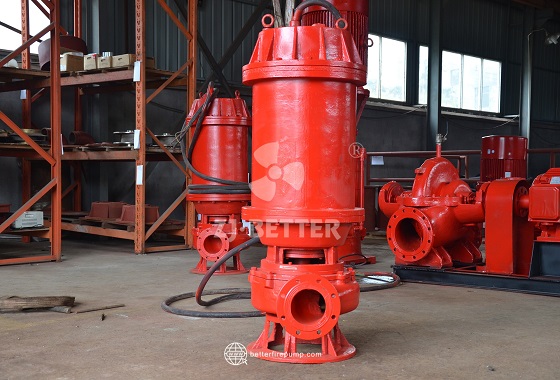
Submersible fire pumps are firefighting equipment with an integrated motor and pump body that is fully submersible. Their operating principle is that the motor directly drives the impeller, drawing water in through the water inlet. The impeller pressurizes the water and discharges it at high speed through the outlet, achieving stable, high-lift water supply. Because the motor and pump body are coaxially mounted and completely sealed, the unit can be placed directly in a water tank or fire water well during operation, eliminating the need for additional suction piping and significantly reducing energy loss. Compared to traditional centrifugal fire pumps that require water priming, the submersible design ensures immediate water delivery, making it particularly suitable for emergency scenarios requiring rapid response.
2. Structural Design: Compact, Safe, and Highly Reliable
The submersible fire pump consists of a submersible motor, impeller, pump casing, mechanical seal, and flow guide assembly. Its compact design and small footprint make it ideal for installation in environments with limited space. Its core components are protected by double-face mechanical seals and multiple sealing rings, ensuring safe operation even when the motor is submerged in water. Furthermore, the pump body is typically constructed of cast iron or stainless steel, offering excellent corrosion resistance. The motor is equipped with a thermal protection device and a leak detection system, automatically shutting down and alarming in the event of an anomaly, minimizing the risk of equipment damage. These safety features ensure long-term, stable operation in high-humidity, corrosive, or enclosed environments.
3. Installation Advantages: Space-Saving and Reduced Construction Costs
One of the greatest advantages of submersible fire pumps is their flexible and convenient installation. Because it doesn't require a dedicated pump room or complex water suction system, the equipment can be placed directly at the bottom of the water storage tank and connected to the control system via the outlet pipe for immediate operation. This installation method not only saves building space but also reduces piping installation and foundation construction costs. Furthermore, submersible pumps operate virtually vibration-free and noise-free, minimizing environmental impact, making them ideal for locations with strict noise requirements, such as hospitals, residential areas, and shopping malls. Installation and maintenance personnel can perform operations and management solely through the control cabinet, reducing maintenance costs.
4. Performance Features: High Head and High Flow
Submersible fire pumps are designed to meet the dual requirements of high head and high flow. Through optimized impeller structure and flow path design, the pump maintains stable water discharge performance even under high pressure, meeting the water supply requirements of fire sprinkler systems and outdoor fire hydrants. Furthermore, submersible pumps offer a wide range of motor power, allowing for customized configuration based on building size. Their efficient hydraulic system reduces energy consumption by approximately 15%-30%, significantly improving energy efficiency and achieving long-term economical operation. Submersible pumps also offer excellent operational stability, enabling 24-hour uninterrupted water supply without compromising equipment life.
5. Applicable Environments: Coping with Complex and Extreme Conditions
Submersible fire pumps are suitable for a variety of complex environments, particularly where traditional surface pumps are difficult to install or require reliable water delivery. Typical applications include underground parking lots, subway tunnels, mines, chemical plants, ship docks, underground pools, and high-rise buildings. Because the pumps are fully submersible, they can operate reliably even in flooded, waterlogged, or highly humid environments. Furthermore, their explosion-proof, corrosion-resistant, and waterproof ratings can be customized to meet the safety standards of high-risk industries such as the petrochemical industry and offshore platforms.
6. Energy Saving Advantages: High-Efficiency Motor and Optimized Hydraulic System
Submersible fire pumps utilize high-efficiency motors and advanced hydraulic system designs to minimize energy loss and improve overall efficiency. Numerical fluid dynamics optimization of the impeller and fluid channels ensures smoother water flow within the pump, reducing hydraulic friction losses. Some models also feature a variable frequency control system that automatically adjusts the speed based on water consumption, achieving energy-saving operation. Compared to traditional fire pump systems, submersible structures effectively reduce operating power consumption, resulting in significant energy cost savings over the long term. This is particularly beneficial for large commercial buildings or continuously operating industrial facilities.
7. Easy Maintenance: Self-Protection and Intelligent Monitoring System
Submersible fire pumps are designed with ease of maintenance in mind. Their intelligent control system monitors operating conditions in real time, such as temperature, current, and water seepage in the seal chamber. They automatically generate alarms or shut down the system for protection in the event of an anomaly. Because the equipment operates underwater, they employ a modular design, facilitating quick disassembly and replacement of components. Routine maintenance requires only regular inspections of cable seals, oil chamber fluid levels, and mechanical seal conditions. Compared to the complex piping and auxiliary systems of traditional fire pumps, submersible pumps significantly reduce maintenance frequency and labor costs.
8. Safety: Leakage and Dry-Run Protection
In terms of safety, submersible fire pumps feature a dual protection system. Their motors are fully enclosed and waterproof, achieving an IP68 rating, ensuring reliable insulation even under extended submersion. The pump also features a built-in anti-dry-run sensor, automatically stopping when the water level is too low or the water supply is insufficient, preventing mechanical damage from idling. Select models can also be equipped with shock-absorbing structures and electrical isolation devices to further enhance operational safety. These safety features enable submersible fire pumps to quickly start and maintain continuous operation in emergency situations, ensuring the safety of personnel and systems.
9. Expanded Applications: Compatible with Automated Firefighting Systems
Modern firefighting systems are becoming increasingly intelligent. Submersible fire pumps can seamlessly integrate with automatic control systems and remote monitoring platforms, enabling automatic start-up, status feedback, and fault diagnosis. Their control cabinets can be pre-set with multiple operating modes, such as manual, automatic, and linkage control. These modes automatically start the pump and supply water when a fire alarm is triggered, ensuring a timely emergency response. Furthermore, submersible pumps can be integrated with sprinkler systems, voltage regulators, and backup power systems, enabling comprehensive intelligent fire water management.
10. Economic and Social Benefits: Reliable Equipment Ensures Public Safety
The widespread use of submersible fire pumps not only improves building fire safety levels but also brings significant economic and social benefits. Their energy-efficient and efficient operation reduces energy waste, extends service life, and reduces equipment replacement frequency, saving users long-term maintenance costs. Furthermore, their compact design and simple installation significantly shorten project cycles and improve construction efficiency. More importantly, in emergencies like fires, submersible fire pumps can quickly provide sufficient water, buying valuable time for rescue efforts and minimizing casualties and property losses.
Submersible fire pumps, with their unique operating principle, stable structural design, and superior performance, have become an indispensable component of modern firefighting systems. Not only can they maintain efficient operation in extreme environments, they also offer multiple advantages, such as energy conservation, safety, and intelligence, making them suitable for a wide range of complex scenarios. From engineering applications to emergency rescue, submersible fire pumps have demonstrated irreplaceable reliability and value, serving as a vital support for the development of a modern firefighting system.
 WhatsApp me