

1. Vehicle-mounted design enhances mobility and deployment capabilities
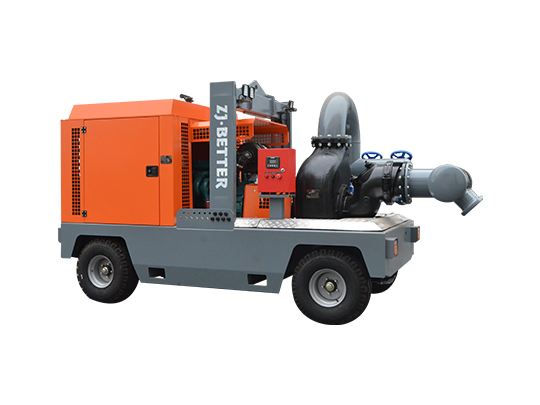
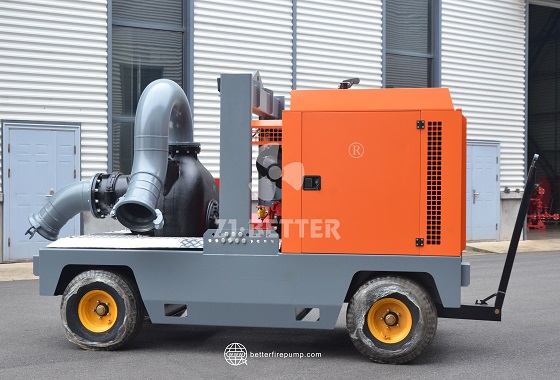
Vehicle-mounted diesel fire pump systems adopt a chassis-mounted or trailer-mounted design, giving the entire equipment excellent mobility and adaptability. Compared to fixed fire pump room equipment, this system can quickly reach the scene via vehicle towing or self-propelled movement, achieving "pump follows the personnel, moving as needed." Where road conditions permit, the equipment can be deployed directly near the fire area, shortening the length of the water supply pipeline, reducing pressure loss, and thus improving firefighting efficiency.
This structural form is particularly suitable for temporary construction areas, mountainous regions, the outskirts of industrial parks, and areas lacking a complete fire hydrant network. The vehicle platform is designed with full consideration of stability and load-bearing capacity, ensuring that the equipment does not easily shift or deform during transportation and operation, providing a reliable foundation for long-term use.
2. Diesel power system ensures independent operation capabilities
Diesel power, as the core energy source of this type of fire pump system, allows the equipment to start independently and operate continuously even without external power. In fire accidents, power outages are common, and fire-fighting equipment relying on mains power often cannot function properly. However, the diesel power system is unaffected by the power grid and has high emergency response capabilities.
By rationally matching the engine power and pump performance, the system can start and stably output water flow in a short time, meeting the water needs of fire hydrant systems, sprinkler systems, or temporary firefighting operations. At the same time, diesel power has the advantages of relatively convenient fuel acquisition and longer storage periods, ensuring the reliability of the equipment even in a long standby state.
3. Integrated structure simplifies on-site operation
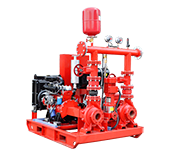
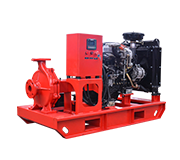
Vehicle-mounted diesel fire pump systems usually adopt an integrated design, concentrating the engine, fire pump, control system, and necessary pipelines on the same platform. The design reduces on-site assembly and complex connection steps, allowing the equipment to be quickly put into operation upon arrival at the site.
The integrated structure not only improves deployment efficiency but also reduces the risk of human error. The control panel is usually centrally located in a prominent position, allowing operators to quickly complete startup, operation monitoring, and shutdown procedures. The overall layout is compact and reasonable, facilitating daily maintenance and inspection, while also reducing safety hazards caused by exposed external pipelines.
4. Flexible adaptation to various water intake and supply methods
This type of system is designed to accommodate various water intake conditions, drawing water from pools, rivers, tanks, or temporary water sources, and continuously supplying water to firefighting equipment through pipelines. By configuring different interface types and pipe diameters, the system can be connected to fire hoses, fixed pipe networks, or temporary sprinkler systems.
This multi-source water intake capability gives the vehicle-mounted diesel fire pump greater adaptability in complex environments. Whether in remote areas lacking fire hydrants or in temporary firefighting systems deployed at accident sites, this equipment can play an important role, providing stable water pressure and flow.
5. High stability ensures continuous water supply
During fire fighting, a continuous and stable water supply is a critical factor in controlling the fire. The vehicle-mounted diesel fire pump system is designed with attention to pump body structural strength and power matching, enabling the equipment to maintain stable output during long-term operation.
By optimizing the cooling system, lubrication system, and vibration control structure, the equipment can maintain smooth operation even under high-load conditions, reducing the risk of downtime due to excessive temperature rise or mechanical fatigue. This high stability makes the system highly reliable in large fires or long-term rescue missions, providing continuous power support for firefighting operations.
6. Suitable for multi-scenario emergency and temporary firefighting needs
The vehicle-mounted diesel fire pump system is not limited to a single application scenario but can be widely used in urban emergency firefighting, temporary firefighting in industrial parks, fire protection at construction sites, and natural disaster relief. In situations where city roads are narrow or water sources are far away, the equipment can be used as a supplementary water supply device.
When a complete fire hydrant network has not yet been established at construction sites or warehouses, this system can undertake temporary fire water supply tasks, improving the fire protection level on site. At the same time, this equipment can also be used for emergency drainage and basic water supply operations after natural disasters such as floods and earthquakes, demonstrating its multi-functional application value.
7. Structural Design Balances Safety and Ease of Operation
The overall structure of this type of fire pump system fully considers safe operation requirements. Key components are installed on a sturdy base or protective frame, reducing the risk of damage from collisions or vibrations during transportation and operation.
The operating area usually has clear markings, making it easy for non-professional personnel to quickly identify key control points in emergency situations. Some systems are also equipped with basic monitoring devices to observe the operating status, thereby improving safety and controllability during use. This design concept makes the equipment more reliable and easier to manage in emergency environments.
8. Easy Maintenance and Daily Management
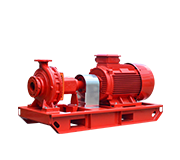
The vehicle-mounted diesel fire pump system usually adopts a modular design in its structural layout, allowing the engine, pump body, and control components to be independent yet coordinated. This layout not only facilitates equipment installation but also simplifies subsequent maintenance.
Routine maintenance mainly focuses on the fuel system, lubrication system, and pump body inspection, with relatively clear maintenance procedures. Regular inspections and test runs ensure that the equipment is in good working condition in emergency situations. Ease of maintenance is particularly important for equipment that is on standby for extended periods, directly affecting its reliability and service life.
9. Adaptable to Different Project Scale Configuration Needs
The vehicle-mounted diesel fire pump system can be flexibly configured in terms of flow rate and head according to different project needs, allowing for customized designs ranging from small-flow emergency equipment to large-flow rescue systems.
In practical applications, users can choose the appropriate specifications based on the scale of the service object, fire extinguishing method, and water supply distance, ensuring that the equipment performance matches the on-site needs. This configurable feature allows the product to serve both small and medium-sized projects and play a role in large-scale emergency engineering, demonstrating strong market adaptability.
10. Enhancing the Overall Reliability of Emergency Fire Fighting Systems
As an important component of emergency water supply equipment, the vehicle-mounted diesel fire pump system can effectively compensate for the limitations of fixed fire fighting systems. When the existing pipeline network is insufficient or unusable, this equipment can be quickly put into use, forming a backup or supplementary water source.
Through reasonable layout and contingency planning, the system can be integrated into the overall fire emergency system, forming a collaborative relationship with fixed pump rooms, fire water tanks, and other facilities, thereby improving overall fire protection capabilities. Its very existence adds an extra layer of safety to fire protection systems, making emergency response more flexible and reliable.
The vehicle-mounted diesel fire pump system, with its flexibility, independent power supply, and suitability for multiple scenarios, has become an important piece of equipment in modern emergency fire fighting and temporary water supply projects. By integrating the power source, pump body, and control system onto a mobile platform, this equipment can be deployed quickly in critical situations, providing a stable water source for firefighting operations.
In urban emergencies, industrial fire protection, and special environment operations, these products not only improve the reliability of fire protection systems but also expand the application scope of firefighting equipment. As the demands for safety and security continue to increase, vehicle-mounted diesel fire pump systems will play an even more important role in emergency water supply.
 WhatsApp me