
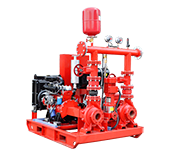
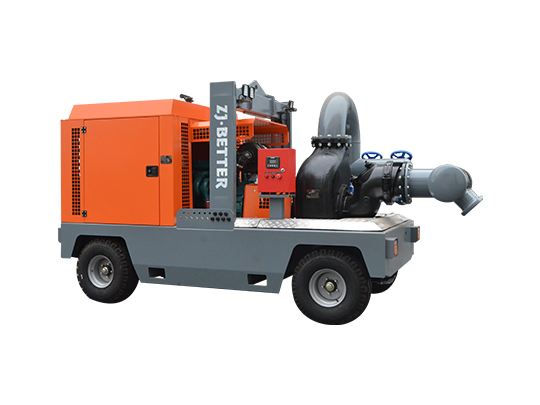
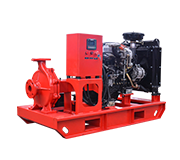
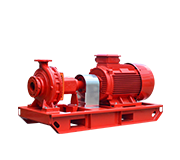

1. Stable and Reliable Power System Ensures High Fire Start-up Success Rate Stationary diesel fire pump units use independent diesel power as their core drive source, maintaining reliable start-up and continuous operation even in extreme situations such as municipal power outages or electrical system damage. This power source allows the fire protection system to be quickly deployed in the early stages of a fire, avoiding water supply delays caused by power failures. Diesel engines typically possess high torque output characteristics, enabling them to reach rated speed quickly, providing stable power support for the fire pump. Meanwhile, its mature mechanical structure and simplified control logic enable it to maintain a high start-up success rate even in complex environments such as high temperature, smoke, and humidity, meeting the stringent requirements of high-standard fire protection engineering for "guaranteed operation in critical moments."
2. High-efficiency hydraulic performance meets the demands of large flow and high head. In large buildings, industrial parks, or infrastructure projects, fire protection systems often need to provide large flow and high pressure firefighting water in a short period of time. Stationary diesel fire pump units prioritize a balance between efficiency and stability in their hydraulic design, achieving high-efficiency energy conversion through optimized pump body flow channels, impeller structure, and sealing methods. This design not only maintains stable output under rated operating conditions but also adapts to varying flow and head requirements within a certain range. For high-standard fire protection engineering, this performance means that reliable pressure and flow can be maintained even when multiple points of water use are used simultaneously, during long-distance transportation, or when supplying water to high-rise buildings, ensuring the overall effectiveness of the fire protection system.
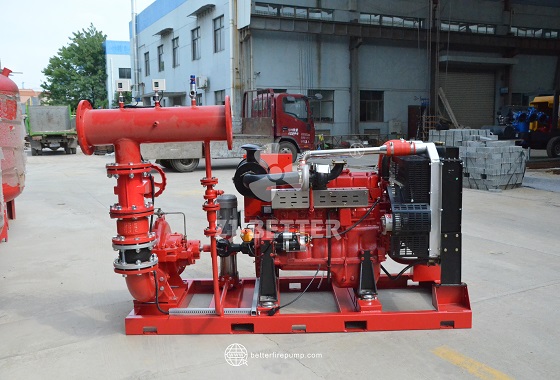
3. Robust structural design adapts to long-term fixed operation conditions. Stationary diesel fire pump units typically adopt an integral base or frame structure, integrating the engine, fire pump, and auxiliary systems onto a unified platform. This structural form, operating in a fixed position for extended periods after installation, places higher demands on the equipment's vibration and fatigue resistance. Through a reinforced steel base, a rational vibration damping design, and reinforcement of key components, the unit effectively reduces the impact of operational vibration on its lifespan. Simultaneously, the stable structural layout helps maintain alignment accuracy between systems, reducing mechanical wear caused by long-term operation, thereby improving the overall reliability and service life of the unit.
4. A Comprehensive Cooling and Lubrication System Ensures Continuous Operation
In high-standard fire protection projects, fire pump units not only require rapid start-up but also the ability to operate continuously to meet prolonged firefighting or water supply demands. Stationary diesel fire pump units are typically equipped with efficient cooling and reliable lubrication systems to ensure engine stability under prolonged high-load operation. The cooling system effectively controls engine temperature through a rational radiator arrangement and air duct design; the lubrication system reduces wear on moving parts through stable oil pressure and high-quality filtration. This systematic design enables the unit to maintain stable performance during continuous operation, meeting the durability requirements of high-standard fire protection projects.
5. Enhanced System Safety Through Automatic Control and Monitoring: Modern stationary diesel fire pump units have continuously improved their control systems, significantly enhancing overall safety and management efficiency through functions such as automatic start-up, operation monitoring, and fault alarms. When a fire signal is triggered or the pipeline pressure is abnormal, the unit can automatically start and enter working condition, reducing delays caused by human intervention. Simultaneously, key parameters such as speed, oil pressure, and water temperature are monitored in real time during operation, and alarms are issued immediately upon detecting abnormalities, alerting maintenance personnel for timely handling. This intelligent control method makes the fire protection system safer and more reliable in high-standard projects, and also facilitates daily management and maintenance.
6. Excellent System Compatibility Meets Diverse Engineering Needs: High-standard fire protection projects often involve various fire protection equipment and complex pipeline systems, requiring high compatibility between equipment. Stationary diesel fire pump units fully consider engineering adaptability in interface design and system configuration, and can be matched with various fire protection pipelines, valves, and control systems. Whether used as a main fire pump or a standby fire pump, it can operate in coordination with the overall system. This excellent compatibility provides high application flexibility in both new construction and renovation projects, reducing system integration difficulty and improving project implementation efficiency. 7. Capability to Adapt to Complex Environmental Conditions: Fire protection engineering applications vary greatly, from underground pump rooms to open-air equipment rooms, from high-temperature areas to cold regions. Equipment must possess excellent environmental adaptability. Stationary diesel fire pump units, through the selection of corrosion-resistant materials, reinforced sealing structures, and reasonable protective designs, effectively cope with adverse factors such as humidity, dust, and temperature fluctuations. Even in harsh environments, they can maintain stable operation. This environmental adaptability makes them more widely applicable in high-standard fire protection engineering.
8. Ease of Maintenance Reduces Life Cycle Costs: During the long-term operation of fire protection systems, equipment maintenance costs and ease of maintenance are equally important considerations. Stationary diesel fire pump units are designed with maintenance space and operational convenience in mind, with a rational layout of key components for easy daily inspection and maintenance. Standardized components and mature technologies reduce maintenance difficulty and downtime. For high-standard fire protection engineering, this not only helps reduce life cycle costs but also ensures that the equipment is always in good condition during critical moments.
9. Design Concept Compliant with High-Standard Fire Protection Codes
High-standard fire protection projects typically require compliance with stringent industry standards and technical requirements. Stationary diesel fire pump units fully consider these standards during the design phase, with systematic planning encompassing performance parameters, safety protection, and structural form. Through reasonable design redundancy and safety protection measures, the stability and safety of the equipment are ensured under various operating conditions. This compliant design concept enhances its reliability during project acceptance and long-term use.
10. Practical Application Value in Key Fire Protection Projects
In large public buildings, industrial facilities, and infrastructure projects, stationary diesel fire pump units have become a crucial component for ensuring fire water supply. Their stable performance and reliable operation enable fire protection systems to respond quickly and provide continuous water supply in critical moments. Through extensive application in actual projects, these units continuously validate their technological maturity and engineering applicability, becoming an indispensable core equipment in high-standard fire protection projects.
In summary, stationary diesel fire pump units, with their independent and reliable power system, efficient and stable hydraulic performance, robust and durable structural design, and good system compatibility, demonstrate outstanding performance in high-standard fire protection projects. Whether in terms of start-up success rate, continuous operation capability, or environmental adaptability, it can meet stringent engineering requirements. These combined advantages make it a crucial choice for ensuring fire water supply safety in modern high-standard fire protection engineering.
 WhatsApp me