
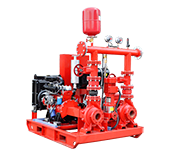
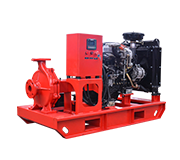

1. Diesel Engine Power System Provides Independent and Reliable Power Source
The integrated diesel engine fire pump system uses a diesel engine as its primary power source, enabling the equipment to maintain stable operation under any circumstances. Compared to fire pumps that rely on electric power, the biggest advantage of the diesel engine drive system is its independence. When a fire occurs, the building's internal electrical system may experience a power outage due to high temperatures, short circuits, or other reasons. In such situations, traditional electric fire pumps may fail to function properly, while diesel engine fire pump systems can still quickly start and continuously supply water using their own power. Diesel engines are characterized by stable power output, high torque, and strong adaptability, enabling them to maintain stable operation under various load conditions. Through a reasonable power matching design, the diesel engine can provide sufficient driving force for the fire pump, maintaining stable water pressure and flow during long-term operation and providing reliable power support for the fire protection system. This independent power structure greatly improves the safety and reliability of the fire protection system in emergency situations.
2. High-Efficiency Centrifugal Fire Pump Structure Improves Water Delivery Efficiency
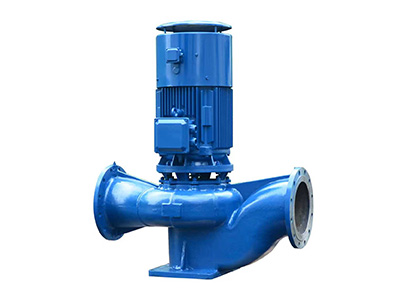
In an integrated diesel engine fire pump system, the high-efficiency centrifugal fire pump is the core component for achieving fire water supply. The centrifugal pump generates centrifugal force through a high-speed rotating impeller, thereby delivering water from the suction inlet to the outlet pipe, achieving stable and efficient water flow. Modern fire pumps typically employ advanced hydraulic model designs, optimizing the impeller structure, flow channel layout, and pump body shape to ensure smooth water flow within the pump body. This optimized design not only improves pump efficiency but also reduces energy loss, enabling the equipment to maintain stable performance even under high flow rates. Simultaneously, high-quality manufacturing processes ensure excellent impeller dynamic balance, reducing equipment vibration and noise and improving overall operational stability. The high-efficiency centrifugal pump structure meets the dual requirements of modern building fire protection systems for water supply capacity and stability.
3. Integrated Structural Design Improves Equipment Installation Efficiency
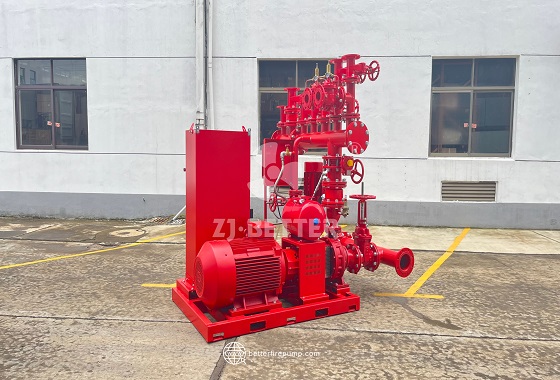
The integrated diesel engine fire pump system adopts an integrated skid-mounted structure design, mounting the diesel engine, fire pump, control system, and piping components on a robust base platform. This design allows for complete assembly and testing before delivery, ensuring compatibility between components. This structural design significantly simplifies on-site installation. On-site, only foundation fixing and piping connections are required for operation, reducing complex on-site construction steps. For large-scale building projects, integrated equipment can significantly shorten the construction cycle, improve installation efficiency, and reduce the possibility of errors during installation, thereby ensuring the overall stable operation of the fire protection system.
4. Rapid Start-up and Response from the Automatic Control System
Modern fire protection systems demand extremely fast response times; therefore, integrated diesel engine fire pump systems are typically equipped with advanced automatic control systems. This system can monitor water pressure changes in the fire protection network in real time. When a pressure drop to a set value is detected, the control system immediately starts the diesel engine and drives the fire pump. The automatic start function significantly shortens the start-up time of fire protection equipment, allowing the fire protection system to be quickly deployed in the early stages of a fire. Rapid response is crucial for controlling the spread of fire. Furthermore, the control system also features manual start, remote monitoring, and fault alarm functions, making equipment management more flexible and safer.
5. High Flow Output to Meet the Fire Protection Needs of Large Buildings
Large buildings are typically equipped with complex fire protection network systems, including automatic sprinkler systems, indoor and outdoor fire hydrant systems, and various fire-fighting equipment such as fire monitors. These systems require a large amount of fire-fighting water during a fire; therefore, the fire pump equipment must have a high flow rate. The integrated diesel engine fire pump system, through a rationally designed pump structure and impeller size, enables the equipment to output a large volume of water in a short time, thereby quickly providing a sufficient water source to the fire protection network. High-flow-rate water supply ensures the simultaneous operation of multiple fire-fighting devices, improving fire extinguishing efficiency and effectively controlling the spread of fire.
6. Stable water pressure ensures normal operation of fire-fighting equipment
In fire protection systems, stable water supply pressure is crucial for the normal operation of fire-fighting equipment. Insufficient water pressure prevents the sprinkler system from forming an effective water curtain, and the range of fire hydrants is also affected. Conversely, excessive water pressure fluctuations can also adversely affect the piping system. Integrated diesel engine fire pump systems, through precise power matching and hydraulic design, ensure stable pressure output under various operating conditions. Stable water pressure not only ensures the normal operation of fire-fighting equipment but also improves fire extinguishing efficiency, allowing the fire protection system to achieve its best effect.
7. Reliable cooling system ensures stable operation over long periods
Diesel engines generate heat during operation, therefore a stable cooling system is essential for long-term equipment operation. Integrated diesel engine fire pump systems are typically equipped with high-efficiency heat dissipation devices and circulating cooling systems to ensure that the engine maintains a stable temperature even during prolonged operation. This cooling system effectively prevents overheating and ensures continuous operation of the diesel engine under high load conditions. Excellent temperature control not only improves equipment operational stability but also extends engine life, enabling fire pumps to operate stably for extended periods in emergency situations.
8. Durable Structural Design Adapts to Complex Building Environments
Modern building fire protection equipment typically needs to operate for extended periods in underground pump rooms or equipment rooms, thus requiring excellent durability. The integrated diesel engine fire pump system utilizes high-strength materials in key components during design and undergoes precision machining and rigorous testing to ensure equipment quality. Pump bodies and piping components are typically made of corrosion-resistant materials, enhancing durability in humid environments. Simultaneously, the overall structure undergoes rigorous vibration and operational testing to ensure stable performance during long-term operation.
9. Convenient Maintenance Reduces Operating Costs
To ensure the fire protection system remains in good working order, fire pumps require regular inspection and maintenance. The integrated diesel engine fire pump system is designed with maintenance needs in mind, employing a rational layout that facilitates easy inspection and replacement of key components. The clear equipment structure and independent system modules allow maintenance personnel to quickly complete routine inspections and maintenance. This convenient maintenance design not only improves equipment management efficiency but also reduces long-term operating costs.
10. Widely Used in Modern Building Fire Protection Engineering
10. Widely Used in Modern Building Fire Protection Engineering
Integrated diesel engine fire pump systems are widely used in various modern building fire protection projects due to their reliable performance and efficient water supply capacity. These include high-rise buildings, commercial centers, underground parking garages, hospitals, airports, industrial plants, and large warehousing and logistics centers. In these environments, fire protection systems require high reliability, and diesel engine fire pump equipment can provide a stable water supply under any circumstances, providing crucial support for fire protection facilities. Its wide applicability makes it an indispensable piece of equipment in modern building fire protection engineering.
In summary, integrated diesel engine fire pump systems, through independent diesel engine power, high-efficiency centrifugal pump structure, and advanced automatic control technology, provide a stable and reliable water supply solution for modern building fire protection systems. This equipment not only boasts advantages such as rapid start-up, high flow output, and stable water pressure, but also features a compact structure, convenient installation, and simple maintenance. With the continuous expansion of urban building scale, integrated diesel engine fire pump systems will play an even more important role in future fire protection engineering, providing a solid and reliable guarantee for building fire safety.
 WhatsApp me