
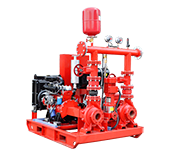
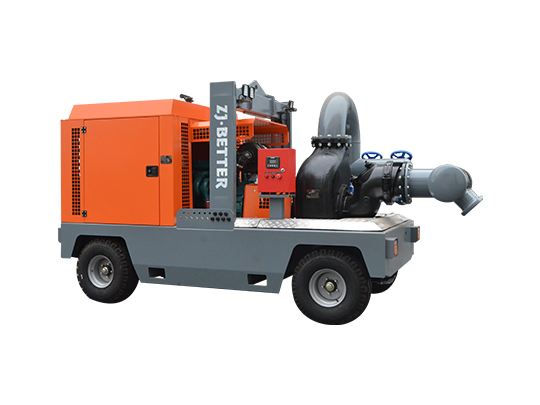
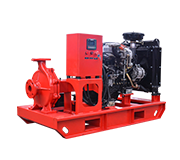
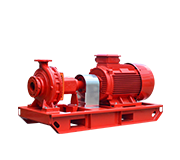

1. High-lift design is the core guarantee for quickly establishing a water source in initial firefighting. High lift is one of the core performance indicators that distinguishes portable fire pumps from ordinary pumping equipment. In the initial stages of a fire, firefighters often need to quickly deliver water to the fire location when the water source is far away or there are elevation differences in the terrain. High-lift portable fire pumps, through optimized impeller structure, hydraulic channels, and internal streamlined design, achieve stable and continuous high-pressure output while maintaining a relatively compact size. This capability allows the equipment to easily handle complex conditions such as high-rise exterior wall spraying, hillside water supply, and deep forest water delivery, fundamentally shortening fire preparation time and gaining a critical window of opportunity to control the fire.
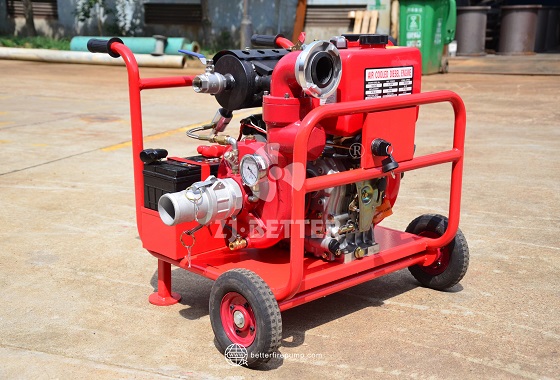
2. Portable Structure Enhances Initial Response Speed Initial fire response emphasizes speed, and a portable structure is a crucial foundation for the rapid response of high-lift fire pumps. These devices typically employ a compact, integrated layout, with the engine, pump body, and control components rationally integrated and protected and supported by an open or semi-enclosed steel frame. This design not only reduces overall weight but also allows the equipment to quickly reach the fire scene via manual pushing or rapid vehicle loading. Compared to stationary fire pump systems, portable fire pumps require no complex installation and can be put into use immediately, significantly reducing the time lag between fire detection and the formation of effective water spray.
3. High-Pressure Stable Output Enhances Initial Firefighting Efficiency
In the early stages of a fire, before the flames have spread extensively, a high-pressure, concentrated, and continuous water flow is often more effective than a large flow rate in extinguishing the fire. High-lift portable fire pumps, through stable pressure output, enable the water flow to form a long-range, highly penetrating water jet, effectively covering the core area of the fire. This characteristic is particularly important when fighting fires on building facades, stack fires, and fires involving combustible materials under forest cover. Stable high-pressure output not only increases the success rate of firefighting but also reduces the time wasted by repeatedly adjusting equipment and nozzle positions.
4. Diverse Water Source Adaptability Enhances On-Site Flexibility
In the early stages of a fire, standardized fire-fighting water sources are often lacking. High-lift portable fire pumps are designed with this in mind. The equipment can be flexibly connected to various non-standard water sources such as rivers, ponds, wells, and water tanks. Through excellent self-priming performance and a sealed structure, it ensures reliable operation even under complex water quality and unstable water levels. This strong adaptability allows firefighters to quickly begin firefighting operations without waiting for external water supply conditions to be met, effectively curbing the spread of the fire in its initial stages.
5. Reliable Engine System Ensures Continuous Operation
In initial fire response, equipment reliability directly impacts the continuity of firefighting efforts. High-lift portable fire pumps are typically equipped with mature and stable engine systems, featuring excellent cooling performance and durable design, allowing for continuous operation under high load conditions. Reasonable power matching ensures that the pump outputs high lift without pressure fluctuations due to insufficient power. This stable and reliable power support enables the equipment to maintain a continuous water supply during the initial firefighting phase, avoiding missed opportunities for optimal control due to mid-operation shutdowns.
6. Simplified Operation Design Lowers the Barrier to Entry
Initial fires are often handled first by frontline personnel or on-site workers, placing higher demands on the ease of equipment operation. High-lift portable fire pumps are generally designed with intuitive control layouts, with clear and straightforward start-up, pressure adjustment, and shutdown procedures. Even non-professional firefighters can quickly learn to operate them after simple training. This low barrier to entry makes the equipment more practically valuable in factories, warehouses, rural communities, and other locations, effectively bridging the gap before professional firefighting forces arrive.
7. Robust Structure Adapts to Complex Emergency Environments: Fire scenes present complex environments; high temperatures, vibrations, dust, and moisture all put equipment to the test. High-lift portable fire pumps typically employ a high-strength metal pump body and reinforced base structure. Key components undergo anti-corrosion and wear-resistant treatment, enabling them to withstand long-term outdoor use and frequent handling in emergency scenarios. This structural reliability not only extends the equipment's lifespan but also ensures it can be deployed, used effectively, and successfully in critical moments, providing a solid guarantee for initial fire suppression.
8. Flexible Configuration Meets Diverse Initial Fire Suppression Needs: Initial fires in different scenarios have varying requirements for water supply distance, pump head, and interface types. High-lift portable fire pumps offer strong flexibility in product configuration, allowing for the selection of different inlet/outlet specifications, pressure ranges, and accessory combinations to meet actual needs. This configurability allows the equipment to be used for rapid suppression of a single fire point or in conjunction with multiple water hoses for coordinated operations, significantly improving the overall efficiency of initial fire suppression operations.
9. Reduced Initial Fire Response Costs
Compared to large-scale fixed fire suppression systems, high-lift portable fire pumps offer significant advantages in procurement, installation, and maintenance costs. They require no complex infrastructure, are flexibly deployed, and can be reused in multiple scenarios. This high cost-effectiveness makes them an ideal choice for businesses, communities, and grassroots units when building fire protection capabilities. By effectively controlling the fire in its initial stages, the equipment can also indirectly reduce property damage and production downtime risks caused by fires, demonstrating significant comprehensive economic value.
10. Supplementary and Extended Role in Modern Fire Protection Systems
As fire protection concepts shift from "post-fire suppression" to "prevention and rapid response," high-lift portable fire pumps are gradually becoming an important supplementary equipment in modern fire protection systems. They not only compensate for the insufficient coverage of fixed systems but also provide more flexible and efficient technical means for initial fire response. Through proper configuration and scientific management, this type of equipment can form a good synergy with professional firefighting forces, playing an irreplaceable role in the fire prevention and control system.
High-lift portable fire pumps, with their high-pressure water delivery capacity, rapid deployment characteristics, and wide applicability, demonstrate significant advantages in initial fire response. Whether in areas lacking fixed fire-fighting facilities or in emergency scenarios requiring rapid response, this type of equipment can effectively shorten response time and improve fire-fighting efficiency. Through proper selection and standardized use, high-lift portable fire pumps are not only powerful tools for initial fire suppression but also an indispensable and crucial component of modern fire protection systems.
 WhatsApp me