

1. High-Efficiency Water Intake Capability Provided by Long-Shaft Structure Design
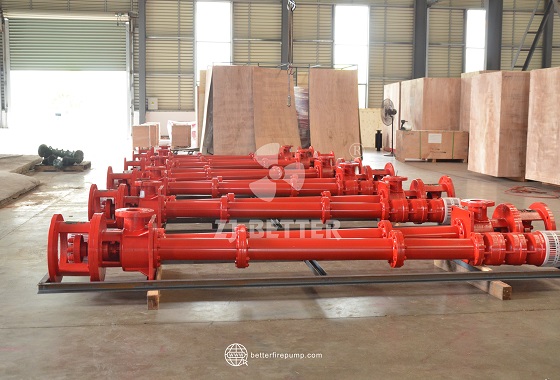
The high-efficiency long-shaft fire pump unit adopts a long-shaft vertical structure design, separating the pump body from the drive unit and stably transmitting power to the underwater impeller through the long shaft. This structure offers significant advantages in water intake conditions such as deep wells, pools, and tanks. Compared with traditional horizontal pumps, the long-shaft structure reduces suction head limitations, avoiding efficiency losses caused by cavitation or insufficient water intake, fundamentally improving water intake stability. The long shaft is precisely machined and supported at multiple points to ensure good coaxiality even at high operating speeds, reducing energy loss. At the same time, this structure can fully utilize the water source depth, achieving low-resistance water intake and providing continuous and stable large-flow water supply conditions for the fire protection system, which is an important foundation for improving overall system efficiency.
2. Optimized Hydraulic Model for Higher Operating Efficiency
This type of fire pump adopts an optimized flow channel structure and high-efficiency impeller profile in its hydraulic design. Computational fluid dynamics analysis is used to continuously refine the water flow path, making the water flow smoother within the pump cavity and reducing turbulence and energy loss. The matching between the impeller and the guide vanes has been repeatedly verified to ensure high-efficiency output even at rated operating conditions and within a certain range of deviations from those conditions. This high-efficiency hydraulic model not only improves the water output capacity per unit of energy consumption but also effectively reduces temperature rise and mechanical load during operation, thereby extending the equipment's service life. For fire protection systems that require long-term standby and immediate startup, high-efficiency operation means lower overall operating costs and more reliable emergency performance. 3. Reduced Energy Consumption and Improved Economic Efficiency of Fire Protection Systems
High-efficiency long-shaft fire pumps significantly reduce energy consumption while meeting the demands for high head and large flow rates. By rationally matching motor power with pump performance, the equipment operates in its high-efficiency range under normal operating conditions, avoiding energy waste caused by oversized motors. For large building complexes, industrial parks, or municipal fire protection projects, although fire pumps are not continuously running equipment, long-term standby and periodic testing still incur energy costs. The high-efficiency design reduces overall energy expenditure without compromising fire safety, improving the economic efficiency and sustainability of the system. This is an increasingly important indicator in current green building and energy-saving projects.
4. Stable and Reliable Long-Term Operation Capability
Fire pumps often need to operate continuously for extended periods during a fire, which places extremely high demands on the stability and reliability of the equipment. High-efficiency long-shaft fire pumps feature reinforced designs in the shaft system, bearings, and sealing structures. Multi-point bearing support effectively reduces axial and radial vibrations, ensuring long-term operation without abnormal wear. Critical components are made of wear-resistant and corrosion-resistant materials, adapting to different water quality conditions and preventing performance degradation due to impurities or chemical components. Stable and reliable operation not only guarantees continuous water supply during firefighting but also reduces the frequency of daily maintenance, providing a solid foundation for the long-term safe operation of the fire protection system.
5. Flexibility to Adapt to Various Fire Water Source Conditions
The high-efficiency long-shaft fire pump is designed with full consideration of the differences in various fire water sources, and can be flexibly applied to various scenarios such as deep well water extraction, underground water tanks, ground water tanks, and open water bodies. The shaft length, pump stages, and head parameters can be rationally configured according to actual project needs, ensuring stable operation even with varying water levels. This high adaptability allows it to be widely used in various fire protection systems in high-rise buildings, industrial plants, petrochemical facilities, and municipal engineering projects, providing greater selection options and technical assurance for design units and owners.
6. Modular Structure Design for Easy Installation and Maintenance
This type of fire pump device usually adopts a modular design concept, rationally dividing the pump body, shaft system, drive device, and connecting components into sections, which facilitates on-site installation and subsequent maintenance. The modular structure makes the equipment safer during transportation, reducing logistical difficulties caused by its overall size. During maintenance, technicians can inspect or replace specific modules without disassembling the entire unit, significantly shortening maintenance time. For fire protection systems, equipment maintainability is equally important; the modular design ensures high-efficiency operation while reducing maintenance difficulty and downtime risks.
7. Excellent System Compatibility and Control Adaptability
The high-efficiency long-shaft fire pump unit is highly compatible with various fire control systems, including automatic start, remote monitoring, and linkage control functions. Through rational configuration of control cabinets and sensing devices, real-time monitoring of pressure, flow rate, and operating status can be achieved, ensuring rapid response and stable operation in the event of a fire. Improved system compatibility allows the fire pump to seamlessly integrate into the overall fire protection system, avoiding potential hazards caused by incompatible interfaces or unstable control. This high level of integration not only enhances the intelligence of the system but also further strengthens fire safety protection.
8. Durable Materials and Precision Manufacturing Ensure Long-Term Performance
In terms of material selection, the high-efficiency long-shaft fire pump unit emphasizes durability and reliability. Key pressure-bearing components are manufactured from high-strength materials, ensuring structural stability under high pressure and heavy load conditions. The shaft surface is specially treated to improve wear resistance and fatigue strength. Precision manufacturing processes ensure the accuracy of the fit between components, reducing efficiency losses and vibration problems caused by manufacturing errors. In the long run, this emphasis on materials and processes not only improves the overall quality of the product but also provides users with a longer service life and lower overall costs.
9. Meeting Strict Fire Protection Standards and Engineering Requirements
The high-efficiency long-shaft fire pump unit strictly adheres to relevant fire protection regulations and engineering standards during design and manufacturing, ensuring that it meets the acceptance requirements of various projects in practical applications. Through reasonable performance testing and operational verification, the pump unit is guaranteed to provide stable and reliable output under rated operating conditions. For engineering projects, compliance with standards not only means successful acceptance but also represents the ability to truly function effectively at critical moments. This type of fire pump achieves a good balance between performance and standards, making it one of the trustworthy core equipment in modern fire protection engineering.
10. Comprehensive Performance Advantages Enhance the Value of the Overall Fire Protection System
From efficient water intake and energy-saving operation to stable reliability and easy maintenance, the high-efficiency long-shaft fire pump unit demonstrates significant advantages in multiple dimensions. These advantages do not exist in isolation, but rather work together to improve the entire fire protection system in terms of safety, economy, and sustainability. For owners and engineering contractors, choosing high-efficiency vertical turbine fire pumps is not only an upgrade at the equipment level, but also a long-term investment in the overall value of the fire protection system.
In summary, high-efficiency vertical turbine fire pump units, with their advanced structural design, optimized hydraulic performance, and excellent operational stability, demonstrate irreplaceable value in modern fire protection systems. They reduce energy consumption while increasing water supply capacity, providing a more reliable and efficient solution for various fire protection projects. As fire safety requirements continue to rise, these high-efficiency fire pump units will play an even more important role in future engineering construction and system upgrades.
 WhatsApp me