
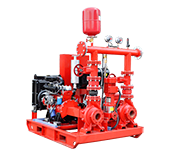
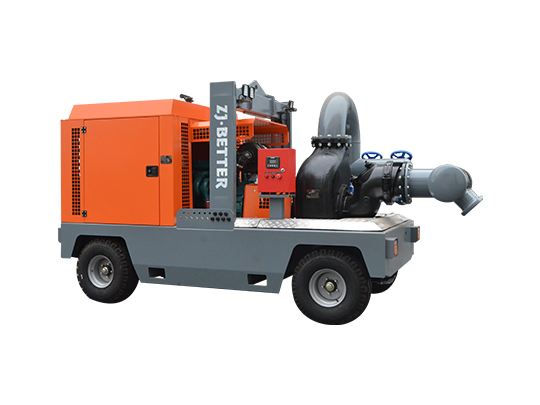
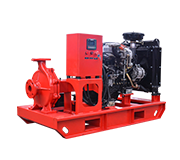
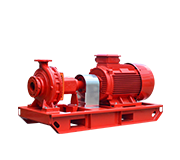
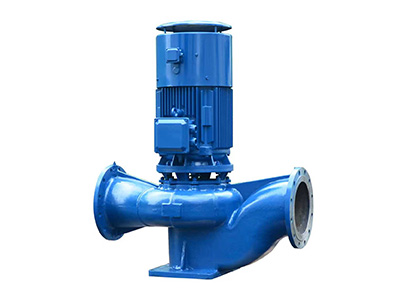

1. Advantages of Compact Overall Structural Design The most prominent feature of the high-efficiency submersible fire pump suitable for confined spaces is its significantly reduced overall height and footprint. Through an integrated direct-drive design of the motor and pump body, the complex couplings and external transmission structures of traditional pump sets are eliminated, allowing the equipment to be directly installed in narrow shafts, tunnels, or equipment rooms. Meanwhile, the pump body typically adopts a vertical or short-shaft structure, effectively reducing lateral space requirements and facilitating installation in confined environments. This compact design not only solves the "space issue" but also significantly shortens pipeline connection lengths, reduces hydraulic losses, and makes the overall system operation more efficient and stable. This structural advantage is particularly important for renovation projects and older buildings, allowing installation without large-scale civil engineering adjustments.
2. High-Efficiency Hydraulic Model Design In confined space applications, equipment often needs to achieve high output under limited power conditions, making hydraulic efficiency crucial. This type of submersible fire pump effectively reduces internal eddies and energy losses by optimizing the impeller flow channel shape, guide vane structure, and pump casing hydraulic profile, maximizing the conversion of input electrical energy into effective head and flow rate. The high-efficiency hydraulic model not only improves the performance of individual units but also significantly reduces energy consumption during long-term operation, saving users operating costs. Simultaneously, stable hydraulic characteristics ensure smoother pump operation under different conditions, reducing vibration and noise caused by flow fluctuations, making it particularly suitable for underground or enclosed spaces with high environmental requirements.
3. Safety and Reliability of Submersible Motors
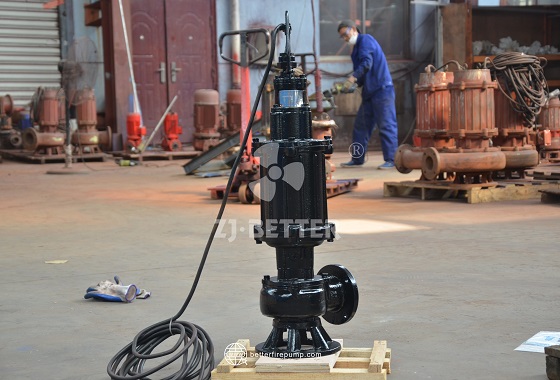
The core of a submersible fire pump lies in its submersible motor, whose reliability directly affects the safety of the entire system. These products generally employ a dedicated waterproof motor structure, with motor windings undergoing multiple insulation treatments and achieving long-term underwater operation through a sealed cavity and mechanical seal system. In confined spaces, where the environment is often humid and ventilation is limited, submersible motors require no additional rain or moisture protection measures and can operate directly in water-filled environments, significantly improving the system's safety level. Furthermore, the motors typically have excellent heat dissipation capabilities, relying on the surrounding liquid for natural cooling, effectively avoiding insufficient heat dissipation due to space constraints, fundamentally ensuring the stability of long-term continuous operation.
4. Capability to Handle Complex Media
In underground spaces or narrow areas, fire fighting and drainage processes often involve silt, impurities, and even fibrous materials. High-efficiency submersible fire pumps are designed with the complexity of the media fully in mind. By increasing the flow channel width, optimizing the impeller structure, and selecting wear-resistant materials, they improve the ability to handle liquids containing impurities. This design effectively reduces the risk of blockage, minimizes downtime caused by foreign objects obstructing the system, and ensures rapid deployment in emergency situations. For applications requiring both flood control and emergency firefighting, this characteristic is particularly crucial, enabling stable output under complex operating conditions.
5. Low Noise and Low Vibration Operation Characteristics: Confined spaces, often close to areas of human activity, such as underground shopping malls, equipment mezzanines, or building shafts, demand high levels of noise and vibration control. High-efficiency submersible fire pumps effectively reduce mechanical vibration during operation through precision-machined rotor systems, dynamic balancing, and optimized bearing configurations. Simultaneously, underwater operation provides excellent sound insulation, resulting in significantly lower overall noise levels compared to traditional surface pump sets. This not only improves the operating environment but also reduces the impact of vibration on surrounding building structures and piping systems, contributing to a longer lifespan for the entire fire protection system.
6. Convenience of Installation and Maintenance: Installing and maintaining equipment in confined spaces has always been a challenge in engineering projects. These submersible fire pumps are designed with construction and maintenance needs in mind, typically employing a modular structure with high integration of key components, reducing on-site assembly work. Installation only requires foundation fixing, cable connection, and pipe connection before commissioning, significantly shortening the construction cycle. In terms of maintenance, the equipment can be quickly disassembled via overall hoisting or a guide rail system, eliminating the need for complex disassembly in confined spaces. This reduces maintenance difficulty and safety risks, making it particularly suitable for fire protection systems with strict time requirements for maintenance.
7. Continuous Operation and Emergency Start-up Capabilities The core value of fire protection equipment lies in its reliability in critical moments. High-efficiency submersible fire pumps suitable for confined spaces are typically designed for continuous operation, maintaining stable performance under prolonged high loads. The matching between the motor and pump body is rigorously calculated to ensure no overload or overheating under rated conditions. Simultaneously, these products offer rapid response and reliable start-up performance, quickly reaching a stable operating state upon receiving fire or drainage commands, buying valuable time for emergency response. This reliable emergency capability is a crucial reason for its irreplaceable role in fire protection systems.
8. Selection of Corrosion-Resistant and Wear-Resistant Materials Water conditions in underground and confined spaces are complex, potentially containing corrosive components or operating in high-humidity environments for extended periods. Therefore, this type of submersible fire pump is particularly meticulous in its material selection. The pump body, impeller, and key flow components are typically made of corrosion-resistant metals or high-strength alloys, and surface treatment processes enhance their rust resistance. Simultaneously, wear-resistant designs are used in easily worn parts, effectively extending the equipment's service life in harsh environments, reducing replacement frequency, and lowering the total lifecycle cost for users.
9. Flexible Adaptability to Multiple Application Scenarios
Although primarily designed for confined spaces, high-efficiency submersible fire pumps are not limited to a single scenario. Their structure and performance parameters possess strong versatility, allowing for application in various situations such as underground garage drainage, subway tunnel fire fighting, municipal flood control, and emergency drainage in industrial plants. Through different installation methods and control strategies, the equipment can flexibly switch between fire water supply and emergency drainage, improving the overall system utilization rate. This multi-scenario adaptability makes it an important component of modern fire fighting and flood control systems.
10. Conforming to Modern Fire Protection System Development Trends
With the development of buildings towards higher density and underground locations, the miniaturization, high efficiency, and high reliability of fire protection equipment have become inevitable trends. High-efficiency submersible fire pumps, suitable for confined spaces, are a prime example of products that align with this trend. Through technological integration and performance optimization, they achieve the functionality of traditional large pump sets within limited spaces, offering more possibilities for fire protection system design and laying a solid foundation for future intelligent and modular fire protection solutions.
Overall, high-efficiency submersible fire pumps for confined spaces, with their compact structure, high efficiency, safety, reliability, and ease of maintenance, successfully solve the application challenges of traditional fire pumps in space-constrained environments. Whether in underground buildings, enclosed passages, or emergency situations requiring rapid deployment, these products demonstrate strong adaptability and practical value. With the continuous improvement of fire safety standards, these submersible fire pumps, combining high efficiency and high reliability, will undoubtedly become an indispensable and crucial piece of equipment in future fire protection systems.
 WhatsApp me