

1. Rapid Start-up Mechanism Ensures Immediate Response
High-efficiency emergency fire pump units employ an optimized startup control system. Upon receiving a fire alarm signal or a sudden drop in pipeline pressure, they can complete self-checks and start up rapidly in a very short time. Compared to traditional equipment that requires longer manual intervention times, this unit achieves "instant response" through automated control, significantly shortening the system's reaction cycle. Especially in the initial stages of a fire, the timeliness of water supply directly affects the speed of fire spread; therefore, rapid startup capability is a crucial indicator of fire protection equipment performance. The system's high responsiveness buys valuable time for firefighting and effectively reduces fire losses.
2. Diesel-Driven Design Ensures Independent Operation
This fire pump unit uses a diesel engine as its power source, eliminating reliance on an external power system. Even during grid interruptions or unstable power supply, it can maintain continuous and stable operation. This characteristic makes it particularly important in remote areas, outdoor locations, and critical infrastructure. Diesel power offers advantages such as high torque and reliability, enabling continuous and stable power output under high load conditions, ensuring the pump remains in efficient operation and providing uninterrupted water support for emergency firefighting.
3. High Flow Rate and High Head Meet Complex Firefighting Needs
In large industrial facilities or high-rise buildings, fire protection systems often face the dual challenges of long-distance water delivery and high-pressure water supply. This unit, through optimized hydraulic design, achieves a balanced output of high flow rate and high head, meeting water supply needs in various scenarios. Whether delivering water over long distances to a fire scene or providing vertical water supply to high-rise buildings, this equipment can stably output sufficient pressure and flow rate to ensure the normal operation of sprinkler systems and fire hoses, thereby improving overall firefighting efficiency.
4. Skid-mounted structure enables rapid deployment
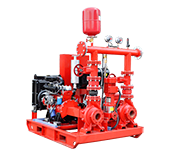
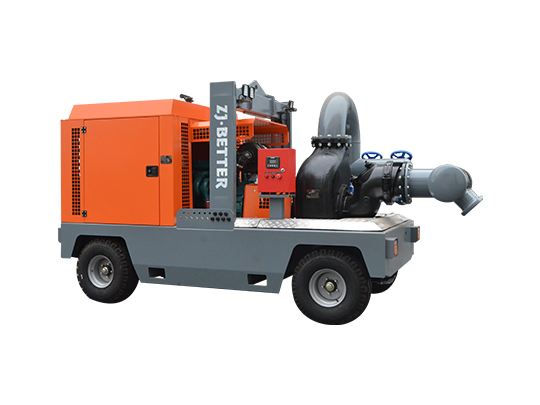
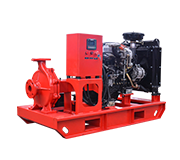
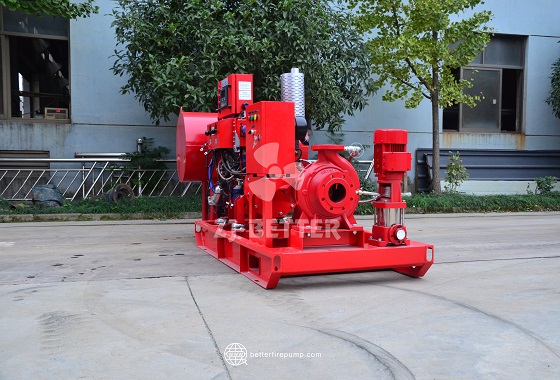
This fire pump unit adopts an integrated skid-mounted design, integrating the diesel engine, water pump, control system, and piping components onto a single base. It undergoes overall commissioning before leaving the factory, requiring only simple connections on-site for immediate use, significantly shortening the installation cycle. This structure not only facilitates transportation but is also suitable for temporary emergency projects or scenarios requiring rapid deployment, such as construction sites, temporary storage areas, or disaster relief zones, greatly improving the equipment's mobility and practicality.
5. Automated control system enhances operational convenience
The unit is equipped with an advanced automatic control system, enabling automatic start/stop, status monitoring, and fault alarm functions. The user interface is intuitive and simple, allowing even non-professionals to quickly master basic operations. The system automatically adjusts its operating status according to pressure changes, reducing human intervention and the risk of misoperation. It also supports switching between manual and automatic modes, ensuring flexible response in different situations and providing higher safety assurance for the operation of the fire protection system.
6. Multiple Protection Mechanisms Ensure Safe Equipment Operation
To ensure long-term stable operation, this unit is equipped with multiple safety protection functions, including overload protection, low oil pressure protection, high temperature protection, and overspeed protection. When the system detects an abnormality, it will automatically issue an alarm and take protective measures to prevent equipment damage. These protection mechanisms not only improve equipment safety but also effectively extend its service life, reduce maintenance costs, and provide users with a more reliable user experience.
7. Durable Design Adaptable to Complex Environments
This fire pump unit is designed with various complex environmental conditions in mind, such as high temperature, low temperature, humidity, and dusty environments. The equipment uses corrosion-resistant materials and protective coatings to effectively resist external environmental erosion. At the same time, key components have excellent sealing performance, ensuring stable operation even under harsh conditions. This highly adaptable design allows it to be widely used in harsh environments such as petrochemical plants, power plants, mining areas, and coastal regions.
8. Continuous Operation Capability Meets Long-Term Firefighting Needs
In actual fires, the firefighting process may last for a long time, placing higher demands on the equipment's continuous operation capability. This unit boasts long-term stable operation capability. The diesel engine and pump body are optimized for matching, allowing continuous operation under high loads without performance degradation. A well-designed heat dissipation and lubrication system ensures stable performance during extended operation, providing reliable support for continuous firefighting.
9. Simplified Maintenance Reduces Operating Costs
The equipment is designed for ease of maintenance, with a rational layout of key components for convenient daily inspection and repair. Commonly used wear parts are easy to replace, reducing downtime. The system also features self-diagnostic capabilities, quickly locating problems and improving maintenance efficiency. By reducing maintenance complexity and frequency, long-term operating costs are significantly reduced, making the equipment more economical throughout its lifecycle.
10. Widely Applicable to Various Firefighting Scenarios
The high-efficiency emergency fire pump unit is suitable for various scenarios, including industrial plants, logistics warehouses, construction sites, municipal engineering projects, and energy facilities. In these scenarios, the equipment can serve not only as part of the main fire protection system but also as a backup or emergency system. Its flexibility and high reliability make it an important component of modern fire protection systems, providing comprehensive safety assurance for different fields.
High-efficiency emergency fire pump units play a crucial role in modern fire protection systems due to their rapid response, independent operation, large flow output, and high reliability. Whether in emergency response to sudden fires or in long-term operation in complex environments, these devices demonstrate superior performance. With increasingly stringent fire safety requirements, this type of high-performance emergency fire protection equipment will become an important development direction for future fire protection engineering, providing safer, more stable, and more efficient fire protection for various locations.
 WhatsApp me