
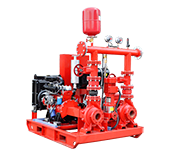
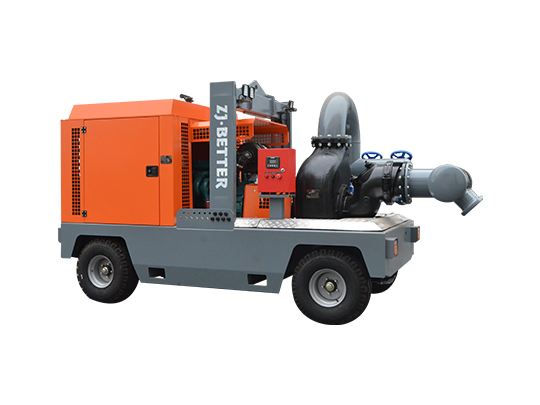
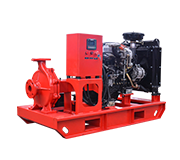
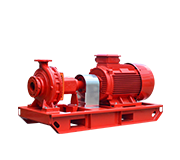

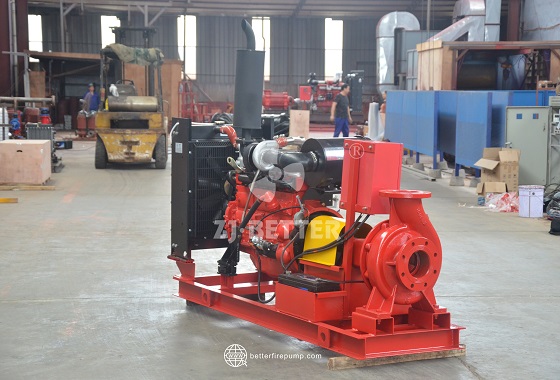
1. Overall Configuration Concept for Stationary Fire Protection Systems The configuration of diesel engine fire pumps in stationary fire protection systems emphasizes system-level reliability and long-term service life. These products typically adopt an integrated or base-mounted structural design, integrating the diesel engine, fire pump body, coupling, control system, and auxiliary piping onto a unified base to form a highly integrated fire water supply unit. This configuration not only reduces on-site installation difficulty but also effectively reduces the number of system connection points, minimizing potential failure risks from a structural perspective. Considering the characteristics of stationary fire protection systems, the product's configuration phase fully considers its compatibility with fire protection piping networks, pressure stabilization systems, and water source conditions, ensuring stable performance of the pump unit in both static standby and dynamic operation. Simultaneously, this configuration concept emphasizes the equipment's ability to start and reach rated operating conditions at any time even after long periods of inactivity. This places higher demands on the design of the diesel engine, fuel system, and lubrication system, fundamentally guaranteeing the reliability of the stationary fire protection system.
2. Advantages of the Stability and Independence of Diesel Power Systems
In stationary fire protection systems, the diesel engine, as the power source, has the greatest advantage of operating completely independently of the municipal power system. Even in extreme situations such as power outages and damage to the power supply system during a fire, the diesel engine fire pump can still start and continuously supply water using its own power. To meet this requirement, the product typically uses a diesel power system specifically tuned for certain operating conditions, emphasizing low-speed, high-torque output characteristics to maintain stable operation under high loads. Meanwhile, the diesel engine is equipped with a complete fuel filtration, lubrication, and cooling system to ensure smooth starting even after prolonged standby. For the continuous operation requirements of stationary fire protection systems, the power system is designed with ample power reserves, allowing the diesel engine to operate under relatively light load conditions at rated operating levels, thereby extending its service life and reducing the failure rate. This stable and independent power characteristic is a crucial guarantee for the reliable operation of stationary fire protection systems.
3. Targeted Design of Fire Pump Hydraulic Performance Diesel engine fire pumps designed for stationary fire protection systems exhibit a clear focus on targeted hydraulic performance design. Products are typically selected and optimized based on the specific flow rate and head requirements of the fire protection system, ensuring that the specified water supply pressure is met even at the most unfavorable points in the system. The pump body is mostly made of high-strength cast materials, and the internal flow channels are optimized to reduce hydraulic losses and improve overall efficiency. For stationary fire protection systems that are in a static state for extended periods, the pump's starting performance is particularly critical. Therefore, these products balance smooth starting and reliable sealing in the impeller structure and shaft seal design, avoiding starting difficulties caused by corrosion or impurity deposits. Through proper hydraulic matching, diesel-powered fire pumps can quickly establish stable water pressure at the first sign of a fire, ensuring a continuous and reliable water supply to the fire protection network.
4. Reliable Configuration of Start-up and Control Systems Fixed fire protection systems have extremely high requirements for start-up success rates; therefore, the configuration of the start-up and control systems for diesel-powered fire pumps is particularly rigorous. The products typically employ a combination of automatic and manual emergency start-up. When the fire protection system detects a pressure drop or receives a start signal, the control system can start the diesel engine and drive the water pump in a very short time. Simultaneously, to prevent single-mode failure, the control system often features multiple start-up logics and redundancy designs. The internal circuit layout of the control cabinet is clear, and key components are selected from industrial-grade products suitable for long-term standby environments, ensuring stable operation even in high-temperature, humid, or dusty environments. Through this reliable start-up and control configuration, diesel-powered fire pumps can meet the core requirements of fixed fire protection systems: "ready to use and successful on the first attempt."
5. Continuous Operation Capability and System Durability In actual fire scenarios, fixed fire protection systems often require continuous water supply for extended periods; therefore, the continuous operation capability of diesel-powered fire pumps becomes one of the key performance indicators. These products are designed with the thermal and mechanical loads of prolonged operation in mind. By strengthening the cooling system, optimizing lubrication circuits, and increasing the strength of key component materials, they ensure stable operation for several hours or even longer under rated conditions. The pump shaft, bearings, and seals are specifically designed to effectively reduce wear rates and extend maintenance cycles. For stationary fire protection systems, this durability not only means reliable operation during a single fire but also that the equipment remains in good condition throughout its many-year service life, providing long-term protection for fire safety.
6. Environmental Adaptability and Installation Flexibility Stationary fire protection systems are used in diverse environments, including underground pump rooms, outdoor equipment areas, or industrial plants. Diesel engine fire pumps are designed with environmental adaptability in mind, employing reinforced structures and protective designs to adapt to varying temperatures, humidity levels, and ventilation conditions. For outdoor or semi-outdoor installations, protective housings or rainproof measures can be provided to enhance overall reliability. Furthermore, the base-mounted structure allows for greater flexibility during installation, facilitating connection to existing foundations and piping networks. This excellent environmental adaptability and installation flexibility enable diesel engine fire pumps to be widely used in various fixed fire protection system scenarios, meeting the actual needs of different projects.
7. Maintenance Convenience and Long-Term Cost Control Fixed fire protection systems emphasize long-term stable operation; therefore, maintenance convenience directly affects the overall operating cost of the equipment. The diesel engine fire pump's structural design fully considers daily inspection and maintenance needs, centralizing commonly used maintenance points for easy and quick inspection and maintenance by staff. The clear layout of the fuel, lubrication, and cooling systems helps reduce maintenance time and the risk of misoperation. Through reasonable maintenance design, the equipment can maintain low maintenance costs throughout its entire lifespan, effectively extending its service life. This not only improves the operational reliability of fixed fire protection systems but also brings higher economic value to users.
8. Safety Protection and Operation Monitoring Configuration In fixed fire protection systems, diesel engine fire pumps not only need to be able to start and operate but also require comprehensive safety protection and monitoring capabilities. The product is typically equipped with multiple operation monitoring devices to monitor key parameters such as diesel engine speed, oil pressure, and water temperature in real time. In case of abnormalities, the system can promptly issue alarm prompts, helping maintenance personnel quickly assess the equipment status. This safety protection configuration is not intended for frequent shutdowns, but rather to ensure the equipment can still operate safely under extreme conditions, allowing for maintenance only after the firefighting mission is completed. Through scientific monitoring and protection design, diesel engine fire pumps achieve a balance between safety and reliability in stationary fire protection systems.
9. Overall Compatibility with Stationary Fire Protection Systems As a crucial component of stationary fire protection systems, the performance of diesel engine fire pumps depends on good compatibility with the overall system. During product design and selection, the relationship with pipeline resistance, sprinkler system requirements, and water source conditions is fully considered to ensure stable operation throughout the system. Through proper matching, the fire pump can avoid frequent overload operation or inefficiency, thereby improving the reliability of the entire fire protection system. This high degree of compatibility makes the diesel engine fire pump not just a standalone device, but an indispensable core unit in stationary fire protection systems.
10. Comprehensive Application Value in Stationary Fire Protection Systems In summary, diesel engine fire pumps for stationary fire protection systems, with their independent power, stable performance, reliable start-up, and good system compatibility, demonstrate significant value in various fire protection applications. Whether for large buildings, industrial plants, or critical infrastructure, these products provide stable and continuous fire-fighting water supply support in critical moments. Their design philosophy not only focuses on single-fire response capabilities but also emphasizes long-term service life and reliable operation over many years, thus building a solid safety foundation for stationary fire protection systems. This comprehensive application value makes diesel engine fire pumps an irreplaceable and essential piece of equipment in modern fire protection systems.
Diesel engine fire pumps designed for stationary fire protection systems, with their scientific configuration schemes and outstanding performance characteristics, provide highly reliable protection for fire-fighting water supply systems. From power independence to hydraulic performance, from start-up control to long-term operational stability, these products are designed and optimized in every aspect to meet the actual needs of stationary fire protection systems. Through reasonable configuration and standardized application, diesel engine fire pumps can operate stably in critical moments, providing solid support for personnel safety and property protection, making them a reliable core device in modern stationary fire protection systems.
 WhatsApp me