

1. Independent Power Supply Design Ensures Stable Start-up Under Power Outage Conditions
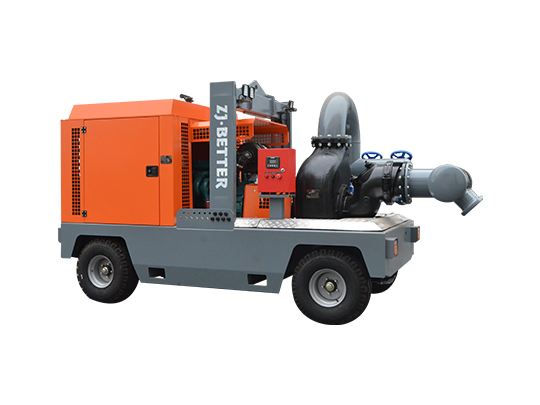
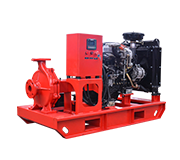
The biggest technical advantage of independently powered diesel fire pump systems lies in their complete independence from the external power grid. During a fire, municipal power often faces the risk of interruption, especially under conditions of high temperature, deflagration, or line damage, where electric fire pumps may fail to start normally. Diesel fire pumps, using an internal combustion engine as their power source, directly output mechanical energy through fuel combustion, enabling rapid self-starting in a complete power outage environment, ensuring the fire protection system is operational immediately. These systems are typically equipped with reliable starting devices and fuel supply systems, ensuring stable output of design flow and pressure even in scenarios involving power failure, insufficient backup power, or unstable power supply, fundamentally improving the reliability and independence of the fire water supply system.
2. Integrated Structural Design Ensures Efficient and Coordinated System Operation
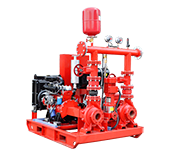
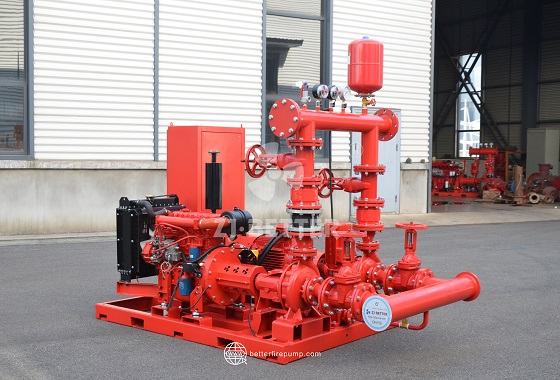
This type of diesel fire pump system is usually supplied as a complete set, highly integrating the power unit, pump body, control system, cooling system, piping components, and base structure. Through a rational system layout, the components work collaboratively, reducing the difficulty of on-site secondary design and installation. The integrated structure not only shortens the construction cycle but also effectively reduces energy loss and failure risks during system operation. Each functional module has been matched and debugged before leaving the factory, ensuring good stability and coordination during operation, making it particularly suitable for fire protection projects with high requirements for system reliability and delivery time.
3. Dedicated Fire Pump Hydraulic Structure Meets High Pressure and High Flow Requirements
The pump bodies used in diesel fire pump systems are typically specially designed for fire protection conditions, featuring high head, high flow rate, and rapid response. Its optimized hydraulic structure allows it to establish stable pressure quickly, meeting the diverse fire-fighting water needs of sprinkler systems, fire hydrant systems, and water cannon systems. The pump's internal flow channel design minimizes hydraulic losses, maintaining stable output even during continuous operation and preventing insufficient pressure in the fire-fighting system due to flow fluctuations. For large building complexes, warehousing and logistics centers, or industrial plants, this type of pump can effectively cover complex pipe networks, ensuring sufficient water supply to all end-point fire-fighting facilities.
4. Automatic Control System Enhances Emergency Response Efficiency Modern diesel fire pump systems are generally equipped with automatic control devices, enabling automatic start-up, operation monitoring, and fault alarms. In the event of a fire, the system can automatically start via pressure signals or fire control system commands, requiring no manual intervention and significantly improving emergency response speed. The control system can monitor operating status in real time, including speed, oil pressure, water pressure, and cooling status, issuing warnings upon detecting abnormalities for timely maintenance. This increased automation makes diesel fire pumps more reliable and efficient in emergencies, while also reducing the potential risks associated with human error.
5. Robust and Durable Structure, Adaptable to Complex Operating Conditions
Diesel fire pump systems are typically designed for long-term standby operation and must possess excellent environmental adaptability. Their overall structure is constructed from high-strength materials, capable of withstanding vibration, high temperatures, humidity variations, and dusty environments. Whether installed in an indoor pump room, a semi-open space, or a separate equipment room, the system maintains stable operating performance. Key components undergo anti-corrosion and rust-proofing treatment, effectively extending the equipment's service life, making it particularly suitable for fire protection applications in complex environments with stringent requirements, such as industrial plants, chemical parks, and ports.
6. Strong Continuous Operation Capability, Meeting Long-Term Firefighting Needs
In large fires or complex fire situations, fire water supply systems often require continuous operation for extended periods. Diesel fire pump systems are designed with continuous operation requirements in mind. Their power system possesses excellent thermal management capabilities, and the cooling and lubrication systems remain stable under prolonged load conditions. Reasonable fuel consumption control ensures that the equipment maintains high-efficiency output during long-term operation, minimizing power attenuation or overheating shutdowns. This feature is particularly important for tunnel engineering, oil tank areas, and large public buildings, effectively ensuring the continuity of firefighting operations.
7. Flexible Installation, Adaptable to Various Engineering Scenarios
This type of fire pump system is designed with different project installation conditions in mind. Its stable base structure allows for direct hoisting or placement installation. The pipeline interface layout is reasonable, facilitating connection with existing fire protection networks. It can be flexibly applied to both new projects and upgrades of existing fire protection systems. For pump rooms or independent equipment rooms with limited space, the complete diesel fire pump system can achieve efficient space utilization through reasonable layout, reducing additional civil engineering costs.
8. Convenient Maintenance, Reduced Long-Term Operation and Maintenance Costs
The ease of maintenance of diesel fire pump systems directly affects the overall operation and maintenance costs during long-term use. This type of product has ample maintenance space in its structural design, and key components are easy to inspect and replace. The control system provides operation records and alarm information, helping maintenance personnel quickly locate problems. Regular maintenance mainly focuses on the fuel system, lubrication system, and starting device. The maintenance process is clear and the cycle is controllable, helping to reduce long-term operating costs and improve the economic efficiency of the equipment throughout its entire life cycle. 9. Aligns with Fire Protection Engineering Application Logic, Enhancing System Reliability
Redundancy and reliability are core principles in fire protection engineering design. Independently powered diesel fire pump systems often serve as primary or backup water supply equipment, complementing electric fire pumps. Even in extreme situations, the system maintains its water supply capacity, improving the overall safety level of the fire protection project at the system level. This configuration is widely used in high-rise buildings, data centers, energy facilities, and important public places, and is an indispensable component of high-standard fire protection design.
10. Applicable to Multiple Industries and Types of Fire Protection Applications
Thanks to its stability and independence, diesel fire pump systems are suitable for various industries and scenarios, including industrial plants, warehousing and logistics centers, commercial complexes, underground projects, municipal infrastructure, and energy projects. Whether used as a main fire pump or as a backup emergency water supply device, the system plays a decisive role in critical moments. Its wide applicability makes it one of the core equipment to be prioritized in various fire protection projects.
In conclusion, independently powered diesel fire pump systems occupy a crucial position in modern fire protection engineering due to their multiple advantages, including independence from electricity, rapid response, stable operation, and adaptability to complex working conditions. Their standardized structure, dedicated hydraulic design, and automatic control capabilities enable them to continuously and reliably provide fire-fighting water in emergency situations, buying valuable time for personnel evacuation and fire suppression. For fire protection projects that prioritize high safety and reliability, this type of product is not merely an equipment choice, but a vital guarantee for system safety.
 WhatsApp me