

1. The Important Role of Diesel Fire Pump Systems in Infrastructure Projects
Large-scale infrastructure projects typically cover vast areas, have dense equipment, and involve frequent personnel movement. Once a fire occurs, it can easily cause severe losses. Therefore, a stable and reliable fire-fighting water supply system is a key component in project construction. The biggest advantage of diesel fire pump systems is that they do not rely on mains power. When a fire causes a power system failure, the diesel engine can start quickly, ensuring a continuous water supply to the fire suppression system. This independent power design is particularly suitable for critical locations such as airports, rail transit, tunnels, power facilities, and chemical projects. Compared to ordinary electric fire pumps, diesel fire pumps have stronger adaptability to harsh environments. They can maintain stable operation even in high-temperature, humid, low-temperature, or dusty environments. For large infrastructure projects, this reliability means that the fire suppression system can play a truly effective role in critical moments. Furthermore, modern diesel fire pump systems typically feature automatic start-up, remote monitoring, fault alarms, and automatic switching functions, enabling unattended operation and significantly improving fire management efficiency.
2. Modular Design Becomes the Development Direction of Modern Diesel Fire Pump Systems
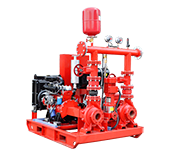
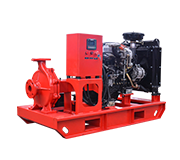
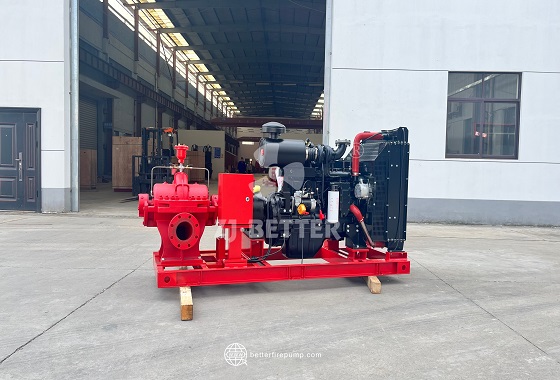
With the continuous shortening of infrastructure construction cycles, traditional on-site installation methods can no longer meet the demand for rapid delivery. Therefore, modular diesel fire pump systems are gradually becoming the industry mainstream. Modular design integrates the diesel engine, fire pump, control cabinet, fuel system, cooling system, and piping system onto a unified base, forming a complete skid-mounted unit. Users only need to complete the basic installation and piping connections for rapid deployment.
This design model offers several advantages:
First, it significantly reduces on-site construction difficulty. Traditional fire pump systems require extensive on-site welding and commissioning, while modular equipment undergoes comprehensive testing before leaving the factory, reducing installation errors.
Second, it shortens project construction cycles. For large-scale infrastructure projects, construction time directly impacts the overall project schedule. Modular equipment enables rapid transportation and hoisting, improving construction efficiency. Furthermore, modular design facilitates later maintenance. The clear layout of each functional module and ample maintenance space effectively reduce maintenance costs.
In the future, with the continuous promotion of prefabricated building concepts, the modular trend of diesel fire pump systems will become even more pronounced.
3. Intelligent Control Systems Enhance the Automation Level of Firefighting Equipment
Modern infrastructure projects have increasingly higher requirements for the intelligence of firefighting equipment, and diesel fire pump systems are upgrading from traditional mechanical equipment to intelligent firefighting equipment. The new generation of diesel fire pump systems is typically equipped with a PLC intelligent control system, enabling automatic start-up, automatic inspection, automatic switching, and remote data transmission. When the pressure in the fire pipeline network drops, the system can automatically identify and quickly start the fire pump.
The intelligent control system can also monitor the following operating parameters in real time:
Engine speed
Water pump outlet pressure
Lubricating oil pressure
Coolant temperature
Battery status
Fuel level
In case of any abnormality, the system will immediately alarm and record the fault information, facilitating timely handling by maintenance personnel. For large infrastructure projects, remote monitoring is particularly important. Managers can view the equipment's operating status in real time through the central control room, achieving centralized management and remote maintenance, improving the overall reliability of the fire protection system. In the future, diesel fire pump systems will be deeply integrated with intelligent fire protection platforms to achieve more intelligent fire-fighting linkage control.
4. High Reliability Design Becomes a Core Requirement for Large Projects
Infrastructure projects often undertake important public service functions; therefore, fire protection equipment must possess extremely high reliability. Modern diesel fire pump systems typically employ multiple redundancy protection mechanisms during the design process. For example:
Dual battery starting system
Automatic and manual dual-mode control
Dual cooling system
Backup fuel supply scheme
Even if a subsystem fails, the equipment can still maintain normal operation.
At the same time, the application of high-quality materials further improves equipment lifespan. The pump body is usually made of high-strength cast iron or stainless steel, and the impeller undergoes precision dynamic balancing, effectively reducing vibration and wear. Diesel engines emphasize long-term continuous operation, meeting the continuous water supply requirements of large-scale fire protection projects. For scenarios such as airports, data centers, and large industrial parks, high reliability is not only related to equipment performance but also to the overall safety of the infrastructure project.
5. Energy Saving and Environmental Protection Drive Product Upgrades
Although diesel fire pumps are primarily used in emergency situations, modern fire protection equipment increasingly emphasizes energy saving and environmental performance. Current diesel fire pump systems generally employ high-efficiency combustion technology, reducing fuel consumption and improving power output efficiency. Simultaneously, optimizing the combustion structure and emission system effectively reduces exhaust pollution.
Some high-end equipment also incorporates low-noise designs, including: Noise-reducing exhaust systems; Vibration-damping bases; Soundproof enclosure structures; Optimized air duct design. These designs are particularly suitable for urban infrastructure projects, reducing the impact of equipment operation on the surrounding environment. Furthermore, intelligent inspection functions reduce unnecessary frequent starts, thereby reducing equipment wear and energy consumption. In the future, continuously upgrading environmental regulations will further drive the development of diesel fire pump systems towards green and energy-saving directions.
6. Adaptability to Complex Operating Conditions Becomes Key to Product Competitiveness
Large-scale infrastructure projects are distributed in complex environments, placing higher demands on fire pump systems.
For example: Port projects face high salt spray corrosion; thin air in high-altitude areas; the risk of freezing due to low temperatures in cold northern regions; and high dust concentrations in desert areas.
Therefore, modern diesel fire pump systems increasingly emphasize environmental adaptability.
In coastal areas, equipment typically uses anti-corrosion coatings and stainless steel piping to improve salt spray resistance; in low-temperature environments, heating systems and antifreeze protection devices are provided; in high-temperature areas, cooling system design is strengthened to ensure stable engine operation. Furthermore, rainproof, dustproof, and shockproof structures have become important configurations in large-scale projects. Only diesel fire pump systems capable of adapting to complex operating conditions can truly meet the needs of global infrastructure construction.
7. Skid-Mounted Integrated Structure Improves Engineering Implementation Efficiency
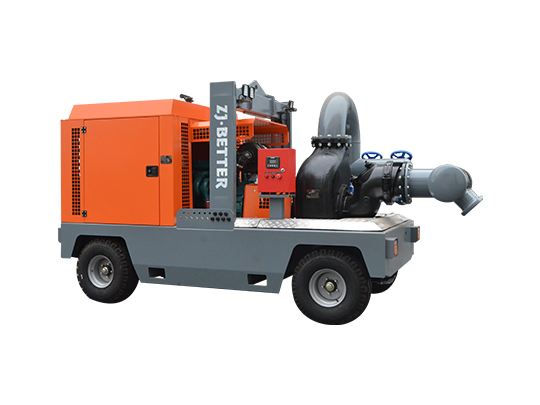
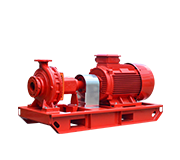
In recent years, skid-mounted diesel fire pump systems have been increasingly widely used in the infrastructure sector. The skid-mounted structure integrates the power system, fire pump, control cabinet, and auxiliary equipment on a steel base, forming a complete unit. Its main advantages include: high installation efficiency, small footprint, convenient transportation, short commissioning cycle, and high system integration. For large-scale engineering projects, the on-site construction environment is complex, and the skid-mounted structure can reduce on-site installation workload and improve overall construction efficiency. At the same time, the equipment has undergone performance testing before leaving the factory, reducing on-site commissioning risks. In the future, as the demand for rapid delivery in infrastructure projects continues to increase, skid-mounted diesel fire pump systems will become an important development direction for the industry.
8. Remote Operation and Maintenance Technology Improves Equipment Management Efficiency
With the increasing popularity of digital management concepts, the operation and maintenance mode of diesel fire pump systems is also changing. Traditional fire equipment maintenance mainly relies on manual inspections, which is not only inefficient but also prone to missed inspections. Modern diesel fire pump systems are beginning to widely apply remote operation and maintenance technology.
Through IoT modules, equipment operation data can be uploaded to the cloud platform in real time, enabling:
Remote status monitoring
Fault early warning
Data analysis
Operation record storage
Maintenance cycle reminders
Maintenance personnel can understand the equipment status without going to the site, significantly improving management efficiency.
For cross-regional infrastructure projects, remote operation and maintenance can reduce labor costs and improve the reliability of fire protection system operation. In the future, artificial intelligence technology will further enhance fault prediction capabilities, enabling more precise equipment maintenance.
9. Multi-pump linkage systems meet the needs of large-scale fire-fighting water supply
Large infrastructure projects typically require ultra-high flow rates of fire-fighting water, making single fire pumps insufficient. Modern diesel fire pump systems increasingly adopt multi-pump linkage designs, achieving more stable fire-fighting water supply through the coordinated operation of main pumps, standby pumps, and pressure-stabilizing pumps.
Multi-pump systems offer the following advantages:
Increased water supply capacity
Ensuring stable pressure
Achieving redundancy
Reducing the load on individual equipment
Improving system reliability. In large warehousing centers, airports, and chemical industrial parks, multi-pump linkage systems have become the mainstream configuration. Intelligent control systems can automatically adjust pump operation modes according to actual working conditions, achieving more efficient and stable fire-fighting water supply.
10. Future development trends of diesel fire pump systems
With continuous upgrades in infrastructure construction, diesel fire pump systems will exhibit the following development trends in the future:
1. Continuously improving intelligence
Future equipment will possess stronger data analysis and automatic diagnostic capabilities, achieving truly intelligent fire protection.
2. Enhanced System Integration
Fire pumps, control systems, monitoring systems, and remote communication functions will be deeply integrated, improving overall operational efficiency.
3. Greater Emphasis on Green and Environmentally Friendly Systems
Low emissions, low noise, and high efficiency will become important development directions for future products.
4. Growing Demand for Customization
Different infrastructure projects have significantly different requirements for fire protection systems; customized design will become an industry trend.
5. Expanding Global Applications
With the increasing scale of international infrastructure construction, diesel fire pump systems will be widely used in more countries and regions.
As a core piece of equipment in modern infrastructure fire protection engineering, diesel fire pump systems are rapidly developing towards intelligence, modularity, energy efficiency, and high reliability. Facing the higher requirements of large-scale infrastructure projects for continuous water supply, safety and stability, and adaptability to complex environments, modern diesel fire pump systems are no longer just fire protection equipment, but also crucial infrastructure for ensuring urban operation and public safety. In the future, with the deepening of the concept of smart fire protection and the continuous advancement of global infrastructure construction, high-performance diesel fire pump systems will play an important role in more key areas, providing more reliable guarantees for the construction of modern fire safety systems.
 WhatsApp me