
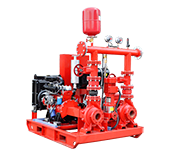
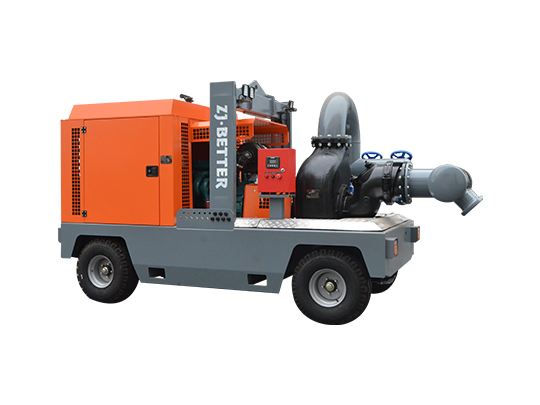
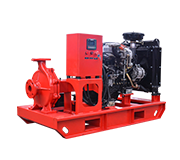
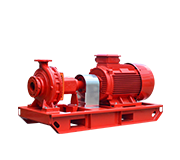

1. Compact Overall Structure
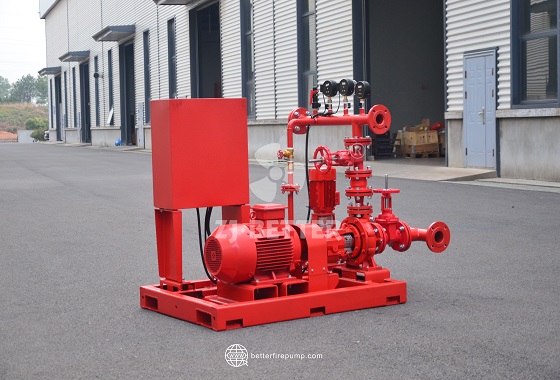
The equipment adopts a unified layout, centrally installing the fire pump, motor, control cabinet, and related piping on a base, effectively reducing the space required for dispersed installation of individual components. The overall structure is clear and suitable for fire protection projects in buildings with limited equipment room space.
2. Stable Power Supply from Electric Motor
The fire pump is driven by an electric motor, which continuously outputs mechanical power to rotate the impeller, thereby pressurizing and delivering fire water. Matching the motor power to the pump's flow rate, head, and operating conditions helps maintain stable equipment operation.
3. Centralized Control Cabinet Management
The equipment is equipped with a control cabinet, allowing for centralized control and management of the fire pump's operating status. Depending on the specific configuration, it can achieve automatic start/stop, operating status display, pressure monitoring, and corresponding fault alarms and protection functions, making equipment operation more intuitive.
4. Flexible Pump Configuration
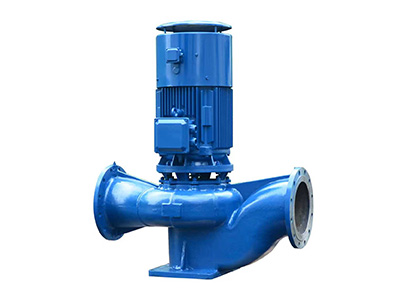
Depending on the flow rate and head requirements of different fire protection projects, end-suction, horizontal split-case, vertical inline, or multi-stage fire pump structures can be selected. This flexible pump configuration can adapt to different building heights, pipe network pressures, and water supply conditions.
5. Stable Fire Water Supply Capacity
Centrifugal fire pumps convert mechanical energy into water kinetic energy and pressure through the high-speed rotation of the impeller, providing the required water volume and pressure to the fire protection pipe network. Through reasonable hydraulic parameter design, the water supply requirements of different fire protection facilities can be met.
6. Centralized Configuration of Piping Components
6. Centralized Configuration of Piping Components
The pump set can be configured with check valves, gate valves, pressure gauges, pressure sensors, flexible joints, and inlet/outlet pipes, etc., according to the system design. The centralized arrangement of these components helps to form a complete fire pumping channel and facilitates on-site connections.
7. Automatic Pressure Monitoring
Pressure sensors or pressure switches can monitor the pressure of the fire pipeline network and transmit relevant signals to the control system. When the pressure changes, the equipment can perform corresponding operations according to preset control logic, improving the automation level of the fire water supply system.
8. Complete Set for Easy Installation
The fire pump, motor, control cabinet, and main piping accessories can be configured as a complete set at the factory, reducing independent procurement and decentralized installation work on-site. The unified base structure also facilitates equipment positioning, transportation, and on-site installation, improving the convenience of engineering construction.
9. Applicable to Multiple Engineering Scenarios
This type of compact fire pump equipment can be used in buildings, warehouses, industrial plants, commercial facilities, docks, airports, and other places requiring fire water supply. Parameter selection based on project design requirements allows for the creation of water supply solutions suitable for different fire protection pipe networks.
10. Enhanced Maintenance and Inspection
With the main equipment centrally located, the connections between fire pumps, motors, control cabinets, pressure components, and valves become clearer, facilitating daily inspections. Reasonable provision of maintenance space allows staff to more easily perform operational checks and maintenance.
Compact fire pump equipment is characterized by motor drive, centralized control, complete configuration, and space-saving installation, rationally combining fire pumps with power, control, and piping components. The product can be flexibly configured according to the flow rate, head, and pressure requirements of different fire protection projects, and its operation is managed through a control system. For fire protection projects with limited equipment room space and a desire for simplified on-site installation, this integrated equipment provides a more compact layout and complete fire water supply functions, offering stable pumping support for building and industrial fire protection systems.
 WhatsApp me