

1. Precision Pressure Monitoring System Achieves High-Sensitivity Feedback
Precision pressure control is the core of the entire fire pump system. Therefore, the pressure monitoring device uses a high-sensitivity industrial-grade sensor capable of sensing changes in pipeline pressure in real time. When slight pressure fluctuations occur, the system can provide feedback through the control terminal and start the corresponding pump unit, ensuring the pressure remains within the preset range. These sensors typically feature strong anti-interference capabilities, stable data, and high measurement accuracy, effectively coping with temperature changes, water flow fluctuations, and external environmental interference. Continuous pressure monitoring maintains the entire system in optimal standby condition, ensuring immediate activation at any critical moment and laying a reliable foundation for fire-fighting water supply.
2. The combination of pressure-stabilizing pumps and main pumps forms an efficient water supply logic. The system generally consists of pressure-stabilizing pumps, main pumps, and standby pumps. The pressure-stabilizing pumps are responsible for maintaining the pipeline pressure at a stable value during normal operation; the main pumps automatically start when the pressure drops to the alarm value to provide a large amount of fire-fighting water. This tiered water supply mode not only ensures the immediate response capability of the fire-fighting system but also avoids the mechanical wear caused by frequent main pump starts. Pressure-stabilizing pumps are characterized by low flow rate, low energy consumption, and high start-up frequency, enabling them to quickly replenish pressure losses caused by minor pipeline leaks or valve operations, thereby ensuring the pipeline network remains in optimal condition for extended periods.
3. Intelligent control cabinet enables automatic judgment and coordinated operation. Precise pressure control relies on a reliable intelligent control cabinet. This control system analyzes pressure signals, flow data, and switch status in real time through control algorithms and automatically starts the pressure-stabilizing pumps or main pumps according to the set logic. When the pipeline pressure is within a reasonable range, the control cabinet remains in standby mode. When the pressure drops to a preset lower limit, the control system immediately starts the pressure-stabilizing pump to replenish the pressure. If the pressure drops further to the main pump's starting value, the control system immediately activates the main pump to ensure sufficient fire-fighting water supply. Simultaneously, the control cabinet features fault detection, self-protection, motor monitoring, and pump unit switching functions, improving the overall system's intelligence and operational reliability.
4. Compact Integrated Pump Unit Design Facilitates Installation and Use
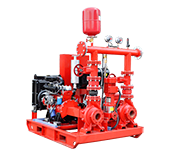
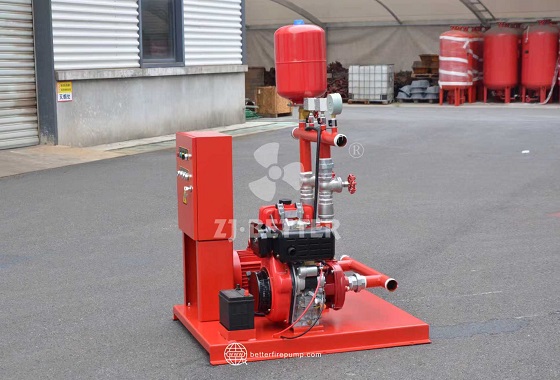
This type of fire pump system typically uses an integrated installation method, integrating the pump body, pressure-stabilizing components, piping, valves, pressure tank, and control cabinet all onto a single base. The compact structure reduces the footprint, making it ideal for projects with limited space, such as equipment rooms or modular fire-fighting unit applications. During installation, only the inlet and outlet water pipes and power supply need to be connected for immediate use, significantly reducing the project timeline. This base structure also enhances overall stability, avoiding vibration transmission and pipe misalignment problems caused by dispersed equipment installation, while providing more convenient operating space for later maintenance.
5. High-Efficiency Centrifugal Pump Body Ensures Continuous and Stable Output
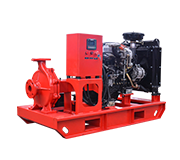
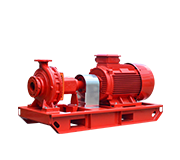
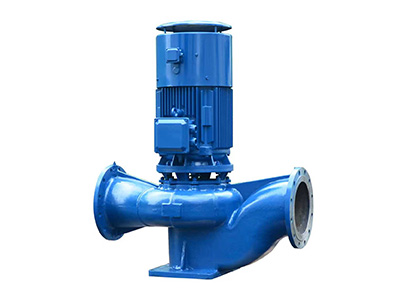
The pump body typically employs a high-efficiency centrifugal design, featuring large flow rate, high head, low noise, and smooth operation. The internal impeller undergoes dynamic balancing to reduce vibration, improve water flow efficiency, and shorten the start-up to stable operation time. A reliable mechanical seal structure ensures the pump body maintains leak-free operation for extended periods under high-pressure conditions. In long-term operation scenarios, the design advantages of centrifugal pumps enable them to provide continuous and stable water output during fire emergencies, enhancing overall fire-fighting capabilities.
6. Multiple Safety Protection Devices Ensure Operational Reliability
In fire-fighting scenarios, equipment stability is paramount. Therefore, the system integrates multiple safety protection measures, including overload protection, phase loss protection, short circuit protection, motor temperature protection, and pump low-pressure protection. These protection devices can immediately cut off power or stop pump operation in case of abnormal conditions, thereby preventing equipment damage and reducing potential risks. Furthermore, the control system has an alarm function, which can promptly report faults through audible and visual alarms, facilitating immediate intervention by engineers and ensuring the fire-fighting system remains in a safe state at all times.
7. Pressure Tank Configuration Enhances System Pressure Replenishment Stability
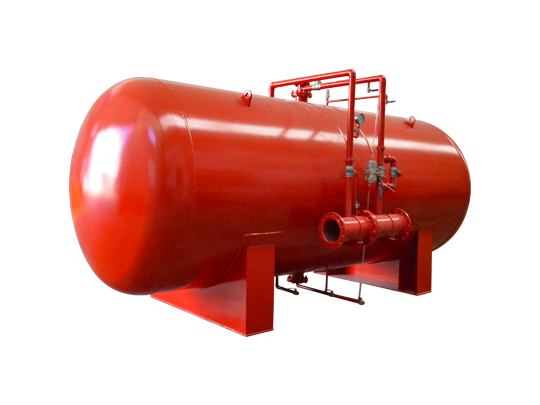
To ensure efficient operation of the pressure-stabilizing pump and reduce start-up frequency, the system is equipped with a pressure tank to store a certain amount of pressurized water. When a slight pressure drop occurs in the pipeline, the compressed air inside the pressure tank pushes the water flow in the reverse direction to replenish the pressure, allowing the system to restore pressure without immediately starting the pressure-stabilizing pump. This design extends the service life of the pump unit and avoids energy waste caused by frequent system starts. Furthermore, the pressure tank volume can be customized according to project requirements to adapt to fire protection systems of different scales.
8. Flexible Application Capabilities for Various Fire Protection Scenarios
Precise pressure-controlled fire pump systems are widely used in various scenarios such as high-rise buildings, residential communities, commercial complexes, industrial plants, warehousing and logistics centers, and public facilities. Its precise pressure maintenance capability ensures that the fire protection pipeline network on each floor of complex building structures always has stable water pressure and can immediately meet the activation requirements of fire extinguishing equipment in the event of a fire. The system's high adaptability also makes it a universal fire pump solution for new construction, renovation, and expansion projects.
9. Reduced Maintenance Ease and Long-Term Management Costs: The clear equipment layout and centralized component design enable maintenance personnel to quickly perform inspections and servicing. Pumps, pressure tanks, valves, pressure gauges, and control cabinets are all located in easily observable and operable positions, facilitating daily inspections. In terms of maintenance, the centrifugal pump's simple structure allows for easy disassembly and replacement of vulnerable parts; the control cabinet features fault code indication for quick problem location. The overall system has low maintenance costs and is user-friendly, making it more suitable for long-term operational projects.
10. Energy-Saving Design Meets the Stringent Energy Requirements of Modern Buildings: The pressure-stabilizing pump employs a low-energy design, requiring only a small amount of electricity to maintain pressure, thus achieving significant energy savings during long-term use in non-fire conditions. The main pump only operates when actual fire-fighting needs arise, avoiding the energy waste caused by frequent main pump starts due to system leaks or pressure fluctuations, as is common in traditional equipment. The intelligent control system also allows users to adjust pressure parameters according to actual needs, ensuring the overall system operates in the most economical way, aligning with the development direction of green buildings.
Precision pressure-controlled fire pump systems, with their high-sensitivity monitoring, stable pump unit combinations, intelligent control capabilities, and outstanding energy-saving performance, have become a crucial foundation for modern building fire water supply. They not only ensure that the fire piping network remains in emergency readiness at all times, but also provide long-term, safe, integrated fire water supply solutions for various engineering projects through stable, intelligent, and reliable operation. Whether in new construction or renovation projects, these systems significantly improve the response speed and reliability of the overall fire protection system, making them indispensable key equipment for ensuring building fire safety.
 WhatsApp me