

1. Analysis of Core Performance Parameters of Diesel Fire Pump Systems The performance parameters of a diesel fire pump system determine whether it can meet the fire water supply needs of an engineering project. These typically include rated flow rate, rated head, speed, power matching, allowable inlet pressure, and net positive suction head (NPSH). In engineering applications, the pump unit needs to operate continuously at specified operating points and ensure stable output under low pressure or long-distance delivery conditions. The selection of the diesel engine must match the pump's performance curve to ensure it reaches its optimal efficiency range at rated speed. Furthermore, a high-quality fuel injection system, a steady-state speed governor, and low fuel consumption configuration can further improve the economy and reliability of the entire equipment. Only through precise calculations and matching with on-site requirements can the pump set achieve efficient water supply and stable operation.
2. Engineering Advantages of the Overall Unit Structural Design
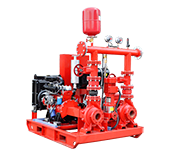
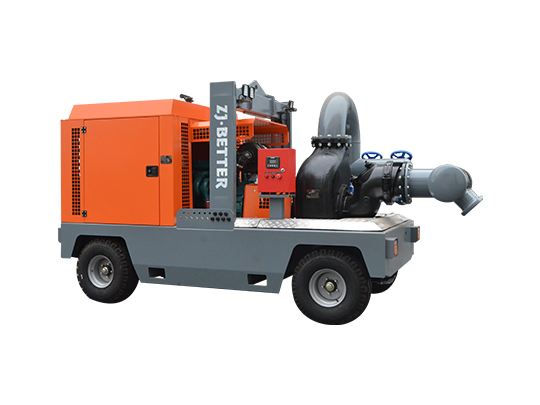
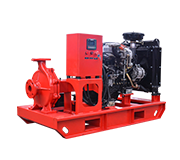
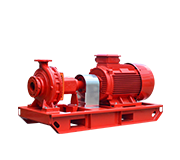
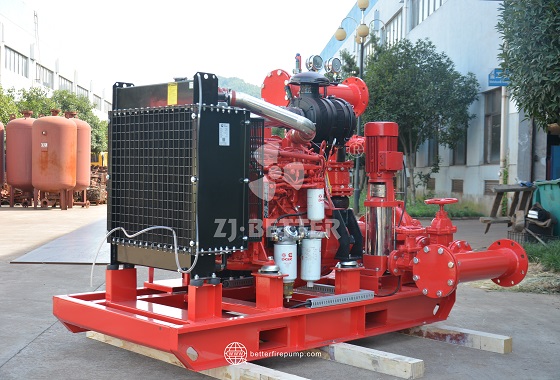
Diesel fire pump systems typically adopt a skid-mounted structure, with all components, including the pump body, diesel engine, transmission components, control devices, fuel system, and cooling system, integrated on a robust chassis. This engineering design not only facilitates transportation and rapid installation but also ensures high overall rigidity, low vibration, and high stability. The base typically uses a thickened steel plate welded structure and is painted for corrosion protection to enhance durability. The pump end often adopts a vertical or horizontal centrifugal pump layout, paired with a flexible coupling to achieve smooth transmission. Through modular structural design, the unit can be easily connected to different types of fire-fighting pipe networks, shortening the construction cycle and improving project adaptability.
3. Reliability and Adaptability Advantages of the Diesel Power System
As the core drive source for fire-fighting water supply, the reliability of the diesel engine is crucial. Modern diesel power systems typically employ electronic fuel injection, high-pressure common rail systems, or mechanical speed regulation structures to achieve stable combustion and power output. In firefighting operations, diesel engines must possess rapid start-stop, instantaneous high torque, and the ability to operate continuously at full load. High-quality diesel engines are usually equipped with low-temperature start devices, oil temperature protection, water temperature alarms, and speed monitoring devices to ensure normal operation even in extreme environments. Furthermore, diesel engines of different power ranges can be multi-stage matched to the pump set's flow rate and head requirements, allowing the unit to flexibly adapt to various engineering scenarios.
4. Continuous Operation Guarantee of Cooling System and Heat Dissipation Structure Diesel fire pumps generate a large amount of heat during continuous high-load operation; therefore, the cooling and heat dissipation system plays a crucial role. Common cooling methods include circulating water cooling and radiator air cooling. Circulating water cooling is suitable for scenarios with well-established fixed pipelines, maintaining a stable temperature through external water supply; while radiator air cooling systems use air heat dissipation and are suitable for engineering environments without an external water source. In system design, parameters such as coolant circulation speed, radiator area, and fan speed must be considered to ensure that the diesel engine does not overheat under prolonged high-load operation. A good heat dissipation structure not only improves the unit's durability but also extends its overall service life.
5. Safety and Fuel Economy Design of the Fuel Supply System The fuel supply system includes components such as the fuel tank, fuel supply lines, filters, and return system. To ensure safety, the fuel tank is typically made of corrosion-resistant steel and equipped with level indicators, vents, leak-proof structures, and fireproof devices. In engineering applications, the fuel tank capacity must meet at least two hours of continuous operation, and some high-standard scenarios require even longer storage capacity. Furthermore, multi-stage diesel filtration devices ensure fuel cleanliness and improve the stability of the fuel injection system. By optimizing the injection quantity and combustion efficiency, fuel consumption can be effectively reduced, allowing the unit to maintain better economy during long-term use.
6. Monitoring and Automation Functions of the Intelligent Control System Modern diesel fire pump systems generally adopt intelligent controllers to achieve automatic pump start-up, operation monitoring, fault alarms, and remote management functions. In a fire emergency, the system can receive fire signals and start immediately without manual intervention, while simultaneously recording operating parameters such as pressure, speed, oil temperature, water temperature, and voltage. The intelligent controller also features self-testing, automatic charging, control switching, and linkage with the fire control center, making the entire system safer and more reliable. In large-scale projects, intelligent monitoring can be interconnected with BMS, fire monitoring hosts, and other systems to improve emergency response efficiency.
7. Engineering Adaptability of Piping System and Connection Methods The pump set piping system includes key components such as suction pipes, discharge pipes, pressure gauges, check valves, gate valves, safety valves, and venting devices. The design must ensure a reasonable piping layout, low resistance loss, convenient operation, and safety and reliability. The suction end is typically equipped with a filter, vacuum gauge, and anti-backflow device to ensure the pump is properly primed before startup. The discharge end is configured with different interface specifications according to project requirements for quick connection to the fire protection network. A good piping structure can improve the overall efficiency of the pump set and reduce the risk of failure due to vibration or frequent starts.
8. Ease of Maintenance and Long-Term Operation Management Advantages
Diesel fire pump systems typically need to be on standby year-round in engineering projects, making ease of maintenance crucial. The unit's structural design must ensure that key components such as oil filters, diesel filters, water filters, belts, and cooling systems are easily inspected and replaced. The control cabinet should have a clear layout and labeling for easy electrical testing by technicians. Simultaneously, the system supports regular automatic inspections, recording operational data to facilitate maintenance planning by management. Standardized maintenance procedures can significantly improve the availability and lifespan of the fire pumps.
9. Wide Range of Application Scenarios
Diesel fire pump systems, due to their high independence and reliability, are suitable for various engineering environments, including industrial parks, petrochemical plants, warehousing and logistics centers, airports and docks, power plant facilities, high-rise buildings, municipal water supply systems, and rural fire stations. Especially in areas with unstable power supply or requiring emergency backup water sources, diesel fire pumps can be used as primary fire-fighting equipment. Their large flow rate, high head, and long-distance delivery capabilities ensure their irreplaceable position in large-scale engineering projects.
10. Engineering System Integration and Customized Configuration Capabilities Different engineering projects have varying requirements for fire water supply flow, head, and pressure. Therefore, diesel fire pump systems possess a high degree of customization capability. The engineering team can adjust pump specifications, diesel engine power, electrical control system functions, fuel tank capacity, cooling methods, and piping layout according to customer needs. For outdoor or harsh environments, rainproof, dustproof, and soundproof enclosures can be added to improve unit operational stability. Through customized design, the system can more accurately meet engineering requirements and improve the overall efficiency and reliability of the fire protection system.
As a critical emergency water supply device in engineering projects, diesel fire pump systems are stable in performance, reliable in power, robust in structure, and highly adaptable, capable of continuous operation in various complex environments. In-depth analysis of performance parameters, structural composition, control technology, and application scenarios reveals the irreplaceable role of this type of equipment in modern engineering fire protection systems. Whether in large factories, high-rise buildings, or municipal and energy projects, diesel fire pump systems provide a solid guarantee for overall fire safety. In the future, with the development of intelligent and modular technologies, diesel fire pump systems will continue to evolve towards higher efficiency, lower fuel consumption, and more intelligent control, providing more reliable solutions for engineering fire protection.
 WhatsApp me