
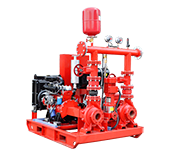
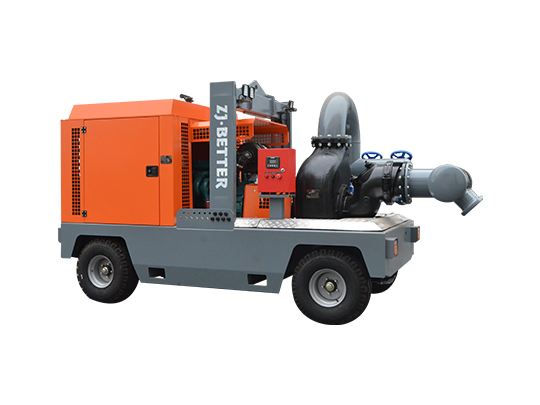
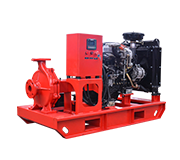
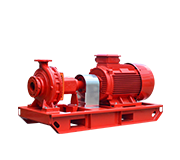

1. Diesel Power System: The Core Foundation for Ensuring Independent Fire Water Supply
The most significant advantage of diesel fire pump systems lies in their power system design, which is completely independent of external electricity. The diesel engine, as the core power source, features rapid startup, stable output, and strong load adaptability, providing reliable power support immediately in emergency situations such as mains power failure or unstable power supply. To meet the special requirements of firefighting conditions, the engine typically adopts a low-speed, high-torque design, ensuring stable operation even under prolonged high-load conditions. Meanwhile, the supporting fuel system, lubrication system, and cooling system are all optimized for "continuous operation" and "instantaneous response," ensuring rapid water supply in the early stages of a fire and maintaining stable output throughout the entire firefighting process, providing continuous power support for the fire protection system.
2. Pump Body Structural Design: Key Support for Efficient Water Delivery and Durability
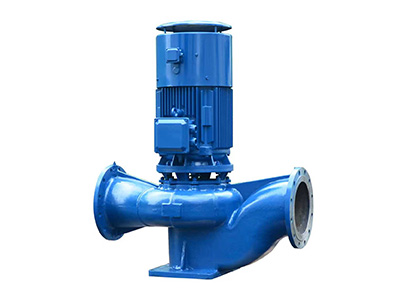
As the core of fire-fighting water supply, the pump body structure plays a crucial role in directly delivering the extinguishing medium. Diesel fire pumps typically employ a centrifugal pump design with high structural strength and a rational flow channel, maintaining good hydraulic efficiency under high head and high flow conditions. The pump casing and impeller are mostly made of high-strength metal materials, and precision casting and machining processes ensure smooth internal flow channels, reducing hydraulic losses. The shaft seal structure balances sealing performance and wear resistance, maintaining stable performance even under frequent start-ups and long standby conditions. This pump body design optimized for fire-fighting applications enables the entire system to possess comprehensive capabilities for rapid water supply, stable pressurization, and continuous operation in critical moments.
3. Power and Pump Matching: The Core Value of System Co-design
The performance of a complete diesel fire pump system does not depend on a single component, but rather on the degree of matching between the power system and the pump body. Through scientific power calculation and speed matching, the output characteristics of the diesel engine can achieve a high degree of synergy with the hydraulic demands of the pump body, avoiding power waste or insufficient load. During the design phase, the engine power is typically configured with reasonable redundancy based on rated flow, head requirements, and fire protection regulations to ensure stable operation even under extreme conditions. This system-level co-design not only improves the overall efficiency of the equipment but also effectively extends the service life of the engine and pump body, a key feature that distinguishes diesel fire pump systems from ordinary industrial pumps.
4. Start-up and Control System: Ensuring Rapid Response in Emergency Situations
In emergencies such as fires, the start-up speed directly affects the fire extinguishing effect. Complete diesel fire pump systems are typically equipped with a dedicated start-up and control system that can switch between automatic and manual start-up modes. When a fire signal is triggered, the control system can quickly complete the start-up command, driving the engine and powering the pump to supply water. The control system integrates multiple operation monitoring and protection functions, enabling real-time monitoring of key parameters such as speed, oil pressure, and water temperature. This ensures safe equipment operation while preventing accidental shutdowns. Through a stable and reliable start-up and control design, the diesel fire pump can be deployed immediately in emergency situations, meeting the stringent response speed requirements of fire protection systems.
5. Integrated Base and Structural Layout: Enhancing Overall Stability and Installation Efficiency
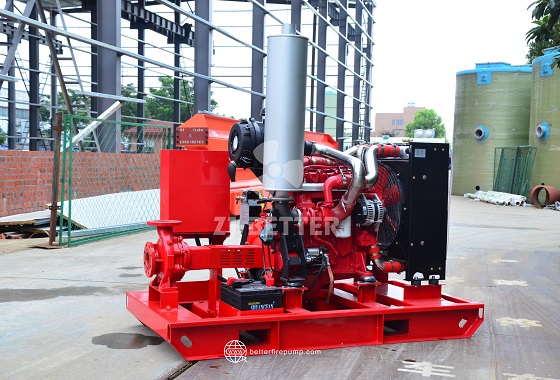
Diesel fire pump systems typically employ an integrated base or skid-mounted structure, integrating the engine, pump, control system, and auxiliary piping onto a unified framework. This integrated design not only improves the structural stability of the equipment during operation but also significantly simplifies on-site installation and commissioning. The base is usually made of high-strength steel, treated with anti-corrosion and vibration damping to effectively absorb vibrations generated during operation and reduce the impact on surrounding facilities. A rational structural layout also facilitates daily inspection and maintenance, ensuring the equipment maintains good operating conditions even during long periods of standby.
6. Cooling and Heat Dissipation System: Adapting to Long-Term Continuous Operation Requirements
Firefighting operations are often characterized by long durations and large load variations, placing higher demands on the equipment's heat dissipation capabilities. Diesel fire pump systems are designed with efficient cooling and heat dissipation systems to address the heat generated by the engine and pump body during operation. Whether water-cooled or air-cooled, the core objective is to ensure critical components remain within a reasonable temperature range under high-temperature environments and prolonged operation. A stable cooling system not only guarantees continuous operation throughout a fire but also significantly reduces the risk of malfunctions due to overheating.
7. Fuel and Range Design: Meeting Continuous Water Supply Requirements in Fire Emergency
In firefighting applications, range is also a crucial performance indicator for diesel fire pump systems. A well-designed fuel system ensures a stable fuel supply to the engine during extended operation, preventing water supply interruptions due to insufficient fuel. The rational design of fuel pipeline layout, safety valve configuration, and filtration system further enhances the safety and reliability of the equipment. Through overall optimization of the fuel system, the diesel fire pump can continuously output power in critical moments, buying valuable time for firefighting operations.
8. System Expansion Capabilities for Multi-Scenario Applications
Diesel fire pump systems are not limited to a single scenario; their system design typically possesses strong expansion and adaptability capabilities. By adjusting pump configuration, pipeline interfaces, and control logic, it can be flexibly applied to various occasions such as industrial parks, warehousing and logistics centers, energy facilities, high-rise buildings, and municipal emergency systems. This multi-scenario adaptability makes diesel fire pump sets a highly versatile core water supply equipment in modern fire protection systems.
9. Maintenance and Reliability Design: Ensuring Availability in Long-Term Standby Conditions
The special characteristic of fire protection equipment is that it is "not used normally, but must be used when needed." Therefore, diesel fire pump sets are designed with particular emphasis on ease of maintenance and long-term reliability. The rational layout of key components facilitates daily inspection and periodic maintenance; the replacement process for routine wear parts is simplified, reducing maintenance difficulty. By reducing unnecessary structural complexity and improving overall system stability, the equipment can maintain good performance in long-term standby conditions, ensuring reliable operation when truly needed.
10. The Advantage of Complete Sets that Meet the Overall Design Concept of Fire Protection Systems
From a system perspective, diesel fire pump sets are not just single products, but also an important component of fire water supply systems. Their complete and systematic design concept organically integrates power, pump body, control, and structure, reducing on-site integration risks and improving system operational reliability. Through this holistic and collaborative design, diesel fire pumps can be better integrated into various fire protection system architectures, becoming a crucial infrastructure for ensuring fire safety.
The complete diesel fire pump system achieves a balance of high reliability, high stability, and strong adaptability through the collaborative design of the power system, pump structure, and various subsystems. Without relying on external power, this type of equipment can provide continuous and stable fire water supply support in critical moments, making it widely applicable to various high-requirement fire protection scenarios. It is precisely this holistic design philosophy from a system-level perspective that makes the complete diesel fire pump system an indispensable core piece of equipment in modern fire protection engineering.
 WhatsApp me