
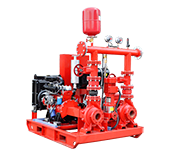
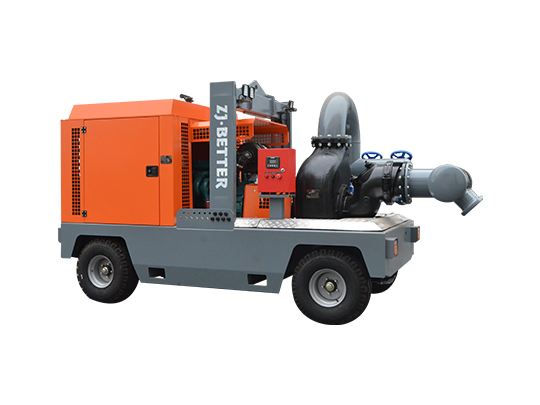
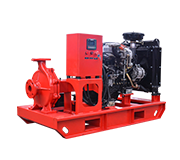
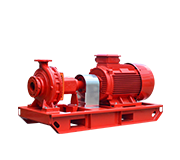

1. Designed Specifically for Maintaining System Pressure
Unlike the main pump, which handles high-flow fire suppression tasks, auxiliary pressure supply fire booster pumps prioritize sensitive detection and timely feedback of pressure changes. Their objective is to quickly intervene when pressure fluctuates slightly, restoring the system to its set value through small-scale water replenishment. This design ensures the fire protection network remains "ready to use" at all times, while preventing false alarms or reduced fire suppression efficiency due to insufficient pressure.
2. Higher Energy Efficiency and Low Flow Rate Operation
These booster pumps typically address minor compensation needs in pipe networks, thus prioritizing efficiency and accuracy in the hydraulic model. Through optimized impeller configuration and power matching, the equipment maintains excellent performance even at low flow rates. This satisfies pressure maintenance requirements while reducing energy consumption, providing economic assurance for long-term operation.
3. Rapid Start-up Reduces Pressure Fluctuations
In practical applications, pressure drops often occur instantaneously. Auxiliary fire-fighting booster pumps can start rapidly upon receiving a signal and restore system balance quickly. Rapid response means that terminal equipment is always in an ideal working environment, contributing to improved reliability of the entire fire protection system.
4. Stable Operation Reduces Impact on Pipelines
If the pressure replenishment process is too abrupt, it can negatively impact pipes and valves. This product, through a smooth output method, ensures a gentler pressure recovery, avoiding water hammer and vibration. Stable operation not only protects system components but also extends overall service life.
5. Compact Structure Facilitates Flexible Layout
The unit's small size and light weight allow for flexible placement based on pump room conditions. Whether in new construction projects or renovation projects, suitable installation space can be easily found. The compact design reduces infrastructure requirements, making construction more convenient.
6. Smoother Collaboration with the Main Pump
Auxiliary pressurization pumps typically work in conjunction with the main fire pump. Through reasonable parameter settings, the booster pump takes over when there is a small pressure drop, while the main pump takes over when a large flow of water is truly needed. This division of labor ensures efficiency and makes the system operation more scientific.
7. Simplified Maintenance and Increased Availability
Because it operates in a standby and low-load state for extended periods, the equipment's structural design fully considers reliability and ease of maintenance. The rational layout of key components makes inspection and maintenance more convenient. High availability means the equipment can be put into operation whenever needed.
8. Extended Main Pump Lifespan
Without auxiliary pressurization equipment, the main pump may frequently start and stop due to small pressure changes. Over time, this not only increases energy consumption but also accelerates wear and tear. The presence of the booster pump effectively reduces this situation, allowing the main pump to focus on the actual firefighting task, thereby extending the overall system lifespan.
9. Applicable to Various Fire Protection System Types
Whether it's a sprinkler system, fire hydrant network, or foam extinguishing system, this type of product can be configured wherever pressure maintenance is required. Its wide adaptability allows designers to apply it flexibly in different projects, providing more options for system solutions.
10. Enhanced System Safety Redundancy
In fire protection engineering, any additional safeguards are crucial. Auxiliary pressure booster pumps, as a supplementary force, add a layer of safety to the entire water supply system. When pressure anomalies occur, they can react immediately, buying time for subsequent measures.
Auxiliary pressure booster pumps play an indispensable role in modern fire protection systems due to their precise pressure maintenance capabilities, rapid response mechanisms, and stable operation. They optimize energy utilization, protect the main pump equipment, and keep the entire pipeline network in an ideal state. In engineering practices that pursue high reliability and high efficiency, this type of product has become an important component in ensuring system safety.
 WhatsApp me